I go to Spinning classes in the company’s Gym once or twice a week.
As I work from home, I usually ride to the office as a warm up exercise. It takes me between 15 and 20 min to get there, so I thought it would be a good opportunity to talk to you.
If you ever have any question for me or want to know something about me, please send me an email through the contact form here in the blog or message me + leave comments on Facebook, YouTube, Twitter, Google+… well, suffice to say, there are a number of ways to get in touch. I will answer these questions or reply to your comments in my next Bike Vlog.
… and then the next one I recorded on my way back home.
Comments always welcome and please rate this post using the stars below.
Thanks for watching!
Please rate this post by clicking on the desired star (1 = Awful, 5
= Excellent)
Welcome to the day 12 post of our Camino de Santiago Pilgrimage by bike which happened on the 5th of June 2015. I did this stage of 63.82 Km or 39.7 miles from Las Herrerías to Sarria in 8h and 05 min, of which 5h 14 min were of actual moving time.
I must confess, I’ve been dreading to write this post as it reminds me of the biggest navigation error I’ve made in the entire pilgrimage. I felt (and still do) like a fool for having done that error, but if this post and video help prevent other pilgrims from doing the same mistakes than it is worth it. My ego can take it 🙂
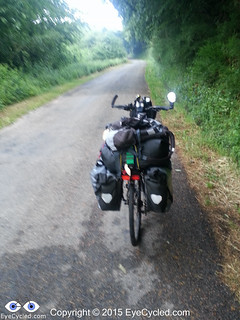
Going uphill between Las Herrerías and La Faba
I left the hostel in Las Herrerías around 7:30am, 30 min earlier than I was used to, because I knew it would be a day of challenges ahead. Fernando had left the hostel about 40 min earlier, I think (he is used to waking up with the birds).
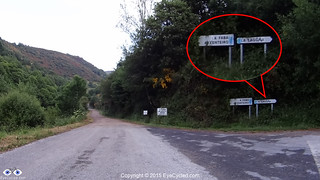
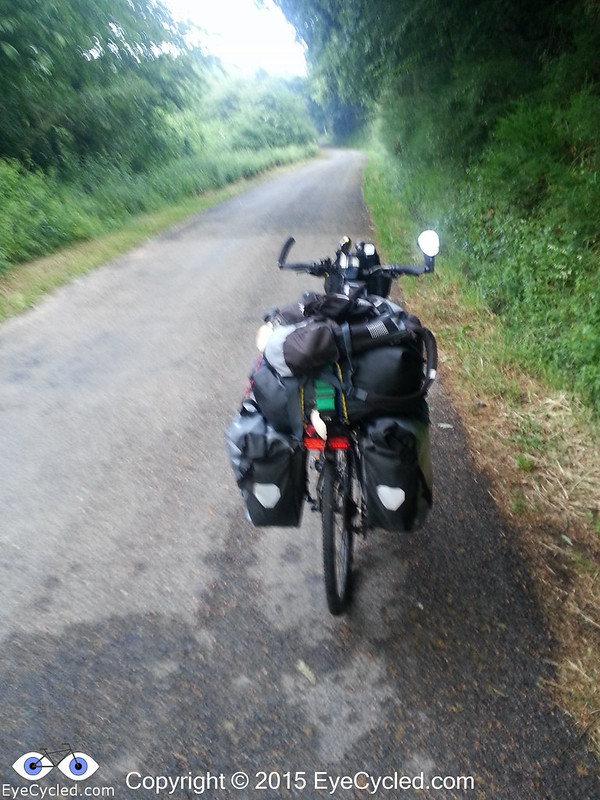
Decision time… La Faba or La Laguna? Should have gone to La Laguna, but went to La Faba.
Full of energy and disposition I started cycling up hill, but without my Navigator by my side (I don’t have a very good sense of direction) it wasn’t long before I made the 1st mistake. When I came to a crossroad junction and had to decide to continue in the direction of La Faba on the small road I was on (labelled CV-125/1) or take another small road to La Laguna (labelled CV-125/15) I decided to continue to La Faba (there was no yellow sign to help out at that point).
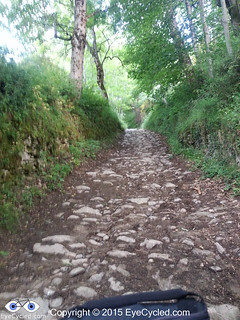
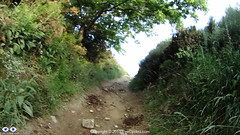
Can you cycle uphill here with a loaded touring bike?One of the many obstacles bike pilgrim must overcome between La Faba and La Laguna.
I must add a note here to say that this mistake is only relevant to those who do the Camino by bike. I essentially took the same route as the walking pilgrims do, which from the village of La Faba onwards is totally unsuitable for most cycling pilgrims. It is a 4 Km long uphill track that even walking pilgrims carrying a heavy backpack would struggle with, I think, let alone those pushing a loaded bike up. So, for anyone reading this post and planning to do the Camino, do yourself a favour and take the road to La Laguna. It is about 2 Km longer, but believe me, it’s worth it!
The “grey” matter left by horses along the way and the inevitable “gazillion” flies around it
The worst part of the 4 Km uphill track actually wasn’t so much having to push the bike up. It was the huge number of flies because of the amount of horse manure left in the track. In Las Herrerías it is possible to “rent” horses to carry the luggage up for you (is that cheating? I don’t think so, as you have to walk it up anyway… the horses only carry the luggage). Obviously the horses leave “stuff” behind when going uphill.
I arrived in La Laguna with a feeling of achievement, but was really tired and it was a slow ascent. So much so that some walking pilgrims that had left the hostel after me, actually caught up with me in La Laguna as I stopped for a few minutes to drink some freshly squeezed orange juice and eat a banana. La Laguna is by far not the end of the ascent to “O Cebreiro“. After La Laguna there are still another 2 Km of uphill which was steep enough to force me to get off my bike again and push (I’d say perhaps a 12% incline in places… about 150m up in 2 Km).
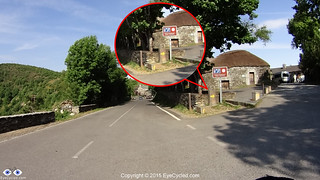
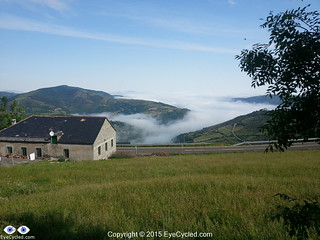
Biggest navigation mistake of my Pilgrimage was here. I failed to see that yellow sign.The view from “O Cebreiro” is spectacular.
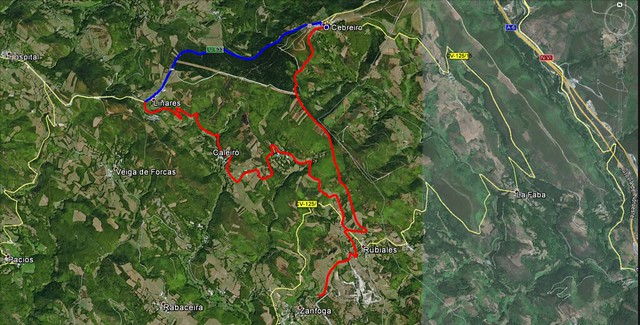
Well, now we come to the point that I got to the Village of “O Cebreiro” and stopped to take a few pictures. Once the pictures were taken I decided not to go into the village (which I should have done) and moved on. Somehow I missed the yellow sign that was actually pointing towards the village. Instead of entering the village, in order to get onto the LU-633 in the direction of Liñares, I continued on the small CV-125/1 and happily rode the wrong way downhill for more than 6 Km until a lady waved at me with the typical “no” gesture. Must confess, by that point I was already suspicious of having taken the wrong route, but God knows how much more I would have traveled if that lady didn’t do this small gesture and took the time to explain to me how to get back to the Camino.
In BLUE, the way I should have taken. In RED, the way I took 🙁
Angels appear in many shapes and forms. We are all angels when we help other people. Religious chatter aside, I feel I can say that for me that it was God who placed that lady there, right when I needed it, to bring me back to the right track, so “Thank you God!”.
Well, as you all can imagine the frustration of having taken the wrong direction for so long was only matched by the realization that I now had to climb another 6 Km again after an already challenging morning climb pushing my bike most of the way up, but that was what the universe wanted me to do at that point, so I did it. Thankfully the directions given by my angel were clear and precise and with some checking along the way I was able to re-join the Camino near the village of Liñares 1h and 38 min later. So the result of my mistake was a loss of about 2h and the need to ride nearly 10 Km or 6 miles more than I should have, of which 8 Km or 5 miles where of steep uphill again.
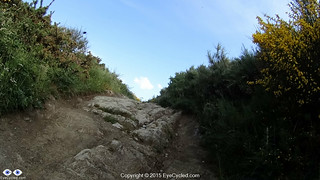
After that, you could think that the rest of the day was a breeze… Well, it wasn’t bad, but as I paid more attention to the yellow signs they led me to paths which were again not suitable for cycling pilgrims after the village of Hospital, but the worst parts of these paths were relatively short compared to what I had endured between La Faba and O Cebreiro in the morning. I would strongly advise though that if you are cycling the Camino you stick to the road (the LU-633) until about 1 Km after the village of Fonfria where you may follow the yellow signs onto the walkers path which is very smooth compared to the previous ones and it will save you some 2 Km over staying on the LU-633.
If you do take the walkers path, about 1 Km after the little village of Fillobal, you will re-join the LU-633 again. From that point onwards I decided I had had enough, no matter where the yellow signs pointed to. I knew that road would take me to Samos and Sarria, but I didn’t know at the time in which city I was going to stay for the night (was aiming Sarria though).
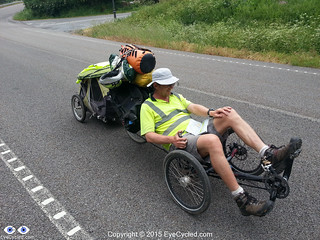
On his trailer, he was carrying his dog.
Along the way I crossed little villages and towns, such as Pasantes, Triacastela (where I met a pilgrim on a recumbent tricycle, pulling a little trailer behind with his dog in it), San Cristovo do Real, Renche, San Martiño do Real and Samos.
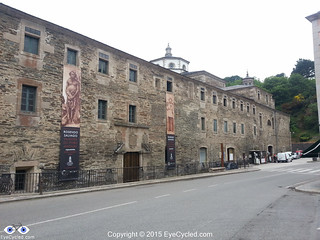
Samos Monastery
I didn’t know at the time, but it was in Samos that Fernando had stopped.
As I arrived in Samos at was still about 2:00pm and I decided to ride further to Sarria, the next town in the Camino. I stopped in Samos just to stamp my Pilgrim’s credential at the municipal hostel and moved on. I added some of Fernando’s pictures here, although I have not experienced the town myself. From Samos to Sarria is just another 12 Km, but I was pretty tired from all the uphill climbing this day, so my plan was to make an early stop there. Crossed through and by tiny villages with distinct Galician names such as A Ferrería, Teiguín, O Vao until arriving in Sarria around 3:00pm. Sarria is a well-developed town and I followed the yellow signs to see if they would take me to a hostel in town.
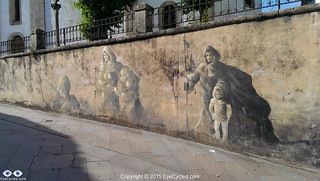
Paintings at the Santa Marina Church, Sarria.
By cheer luck, as I was riding through Sarria I passed by a little souvenir shop and glimpse inside only to see Marcelo and Alice in there. I stopped to say hi and ask what their plans were. At that time they were uncertain if they were going to stay in Sarria or ride a bit further, but when I told them I was pretty tired and was going to stay they decided to stay as well. It just happened that nearby there was a private hostel named Casa Peltre. Alice went to take a look inside and came back saying she thought it was very good (and it was indeed). The overnight was €10 and the albergue is clean and comfortable with a fascinating decoration (take a look at the pictures in their web site). Maria, the “hospitalero” who received us is a really nice person. It is a small hostel and can accommodate only 22 people at once, distributed in 3 bedrooms: A big dormitory room with 14 beds on bunk-beds where we stayed and two other rooms with four beds in each (2 bunk-beds). The hostel has two spacious and very clean bathrooms, with very good and warm pressure showers. It has also a fully fitted kitchen upstairs and a dining area.
Well deserved break. Marcelo in the picture.
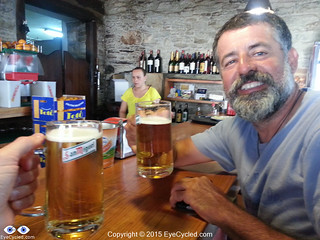
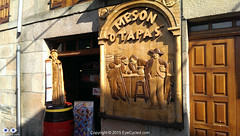
After a warm shower Marcelo and I decided to walk around town to find something to eat (Alice was a bit tired and decided to stay and have a nap). We found a Kebab place by the Sarria river side and filled our bellies with Kebabs. With bellies full we walked around town a bit more until we got to a tapas bar called “Mesón O Tapas” and treated ourselves to some delicious Spanish beers. It was a day filled with mixed emotions: The physical challenge of having to push the bike up some very steep paths full of obstacles, the frustrations of the mistakes I made along the way this day, the blessing of having an Angel direct me to the right path again and the joy to encounter good Camino friends at the end. I certainly could have lived without the mistakes, but it was a good day, in spite of them. Well, that concludes this post about the 12th day of the Pilgrimage. Please feel free to leave comments, questions or at least indicate if you liked it or not by clicking on the stars in the bottom of the post.
Click on the left and right arrows in the picture to navigate through the Slideshow —- Click on the picture to see them in higher resolution in Flickr.
Since I rode from Bracknell to Bath in the middle of August, I wanted to extend that cycling experience to the Bristol and Bath Railway Path, a cycle path built on an old disused railway track between these 2 cities.
So, when my friend Fernando said he also wanted to do it, we united and drove to Bath in the early morning (just 90 min drive from Bracknell) and decided to start the ride in the nice village of Bathampton, close to Bath.
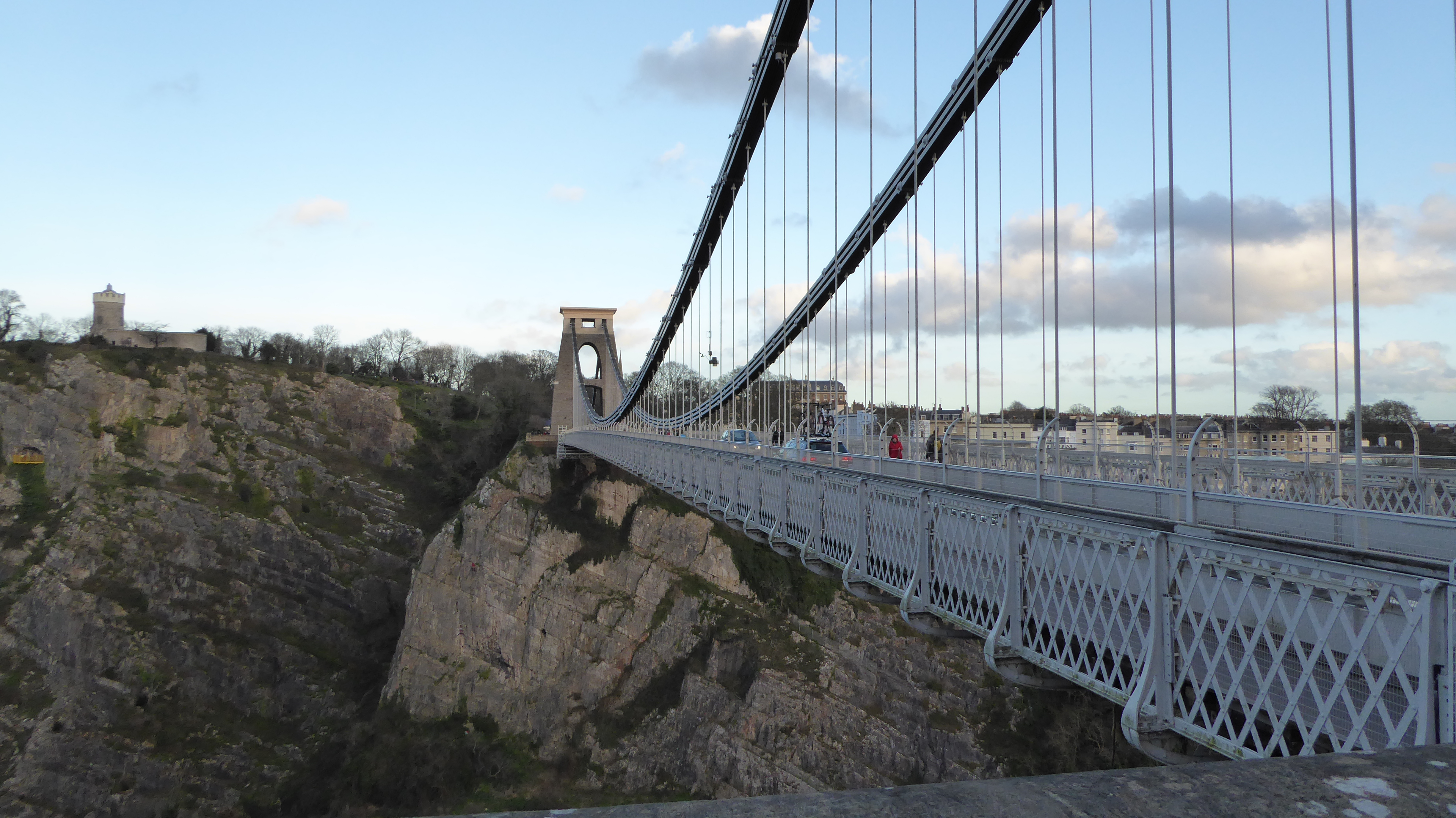
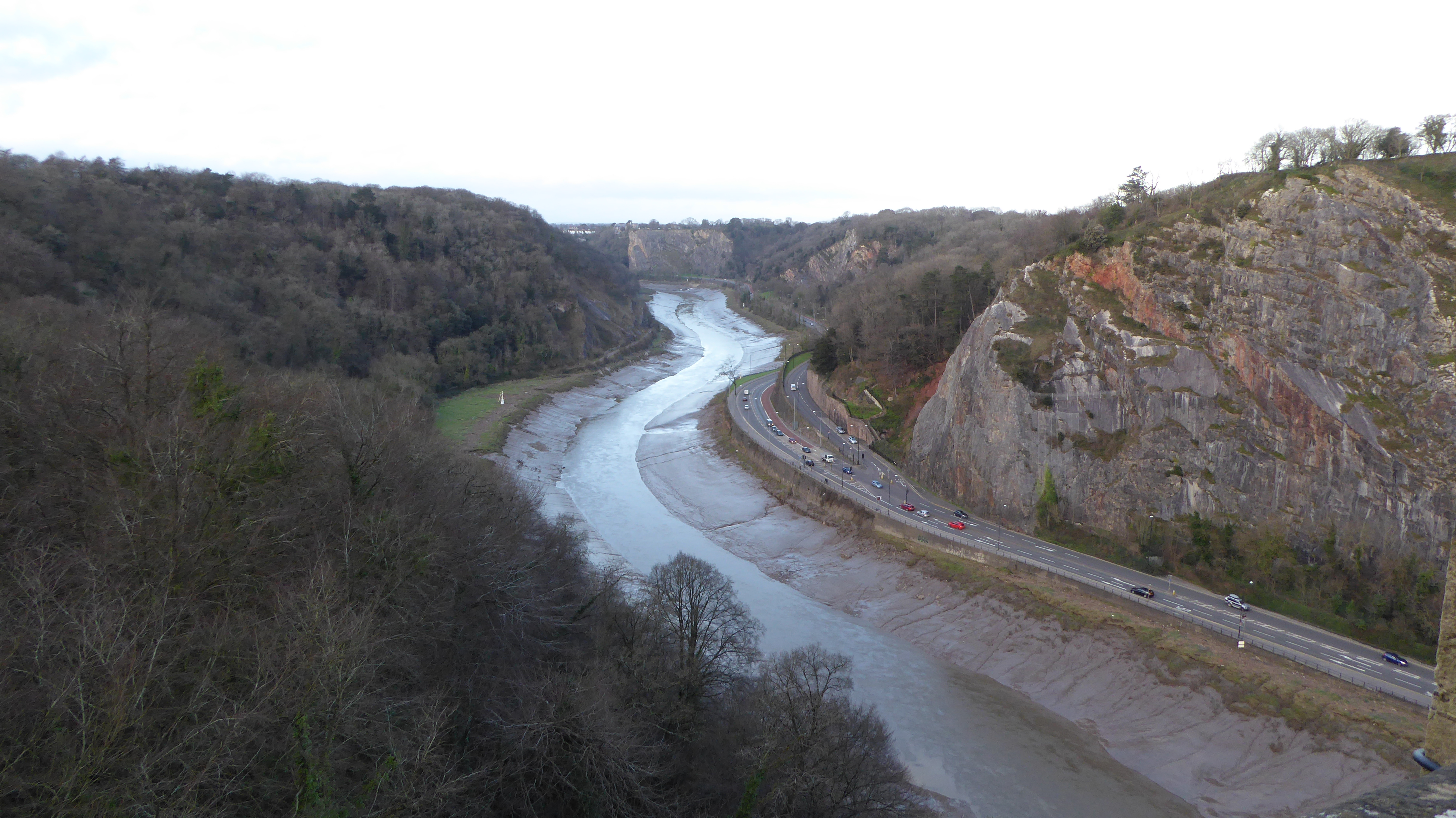
Clifton Suspension Bridge in Bristol
The plan was to cycle the portion of the Two Tunnels Greenway circuit to the towpath of the River Avon and then take a left towards the Railway path and Bristol. As we got to Bristol we decided to go visit the famous Clifton Suspension Bridge, built in 1864, a great feature of Victorian engineering.
The video below shows the entire 3 hours ride in just 20 min.
After arriving at the bridge we took a few pictures and left as we didn’t want to get back to Bath too late (we had still a 90 min drive after that).
I’ve also produced a compilation of “non-accelerated” best moments in the video below.
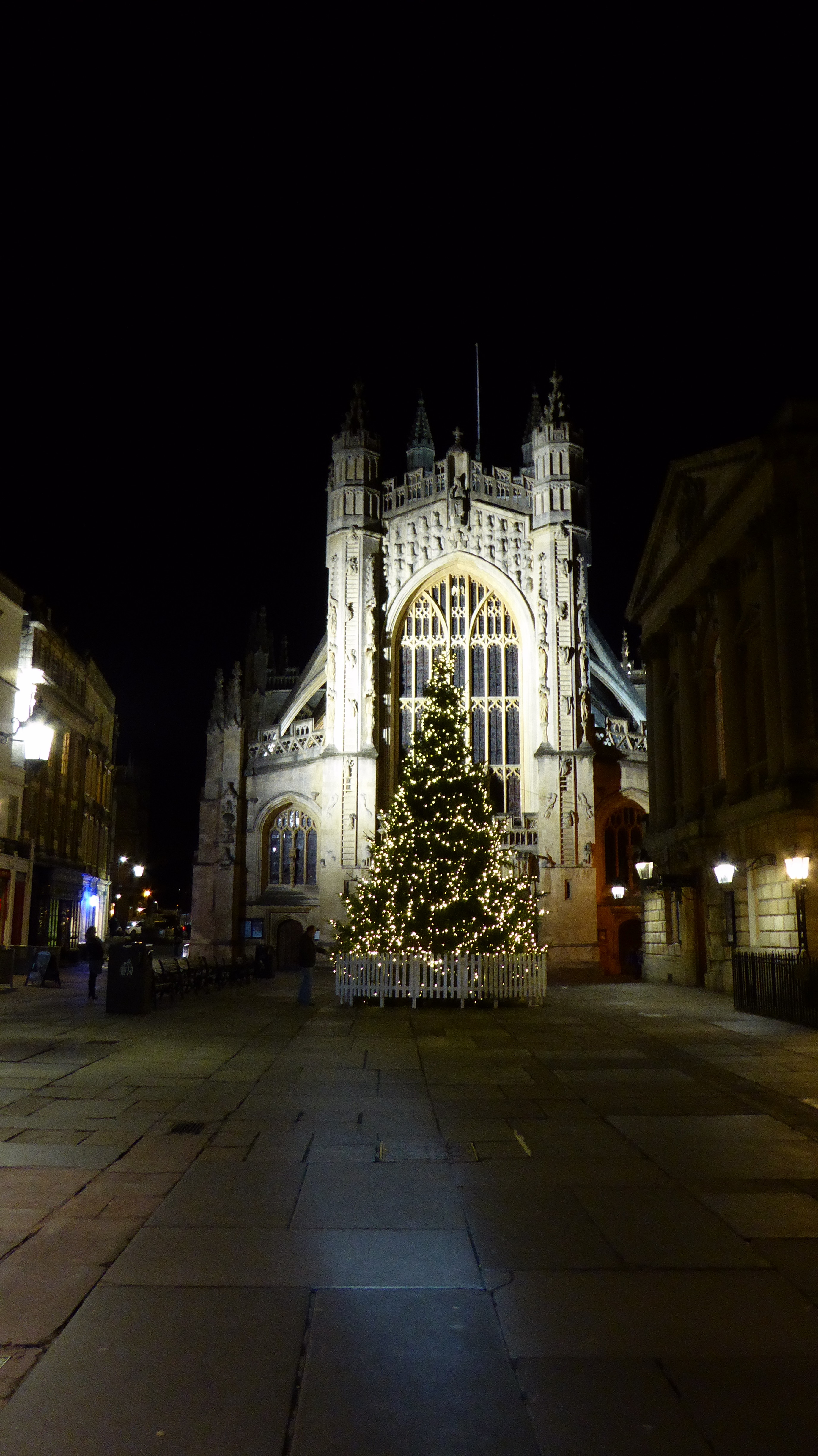
In Bath we had dinner and walked a little bit around the city centre, which still has it’s Christmas lights on, after riding back to Bathampton and driving back to Bracknell. Altogether rode just under 80 Km by bicycle and we left Bracknell at around 9:15am and arrived back at around 10:30pm (incl. the roughly 3h drive from and back to Bracknell)
The video below shows a few moments during the ride back in the early evening and a 360 view on Bath Abbey square at night.
What a great day of cycling. Highly recommended!
More Photos…
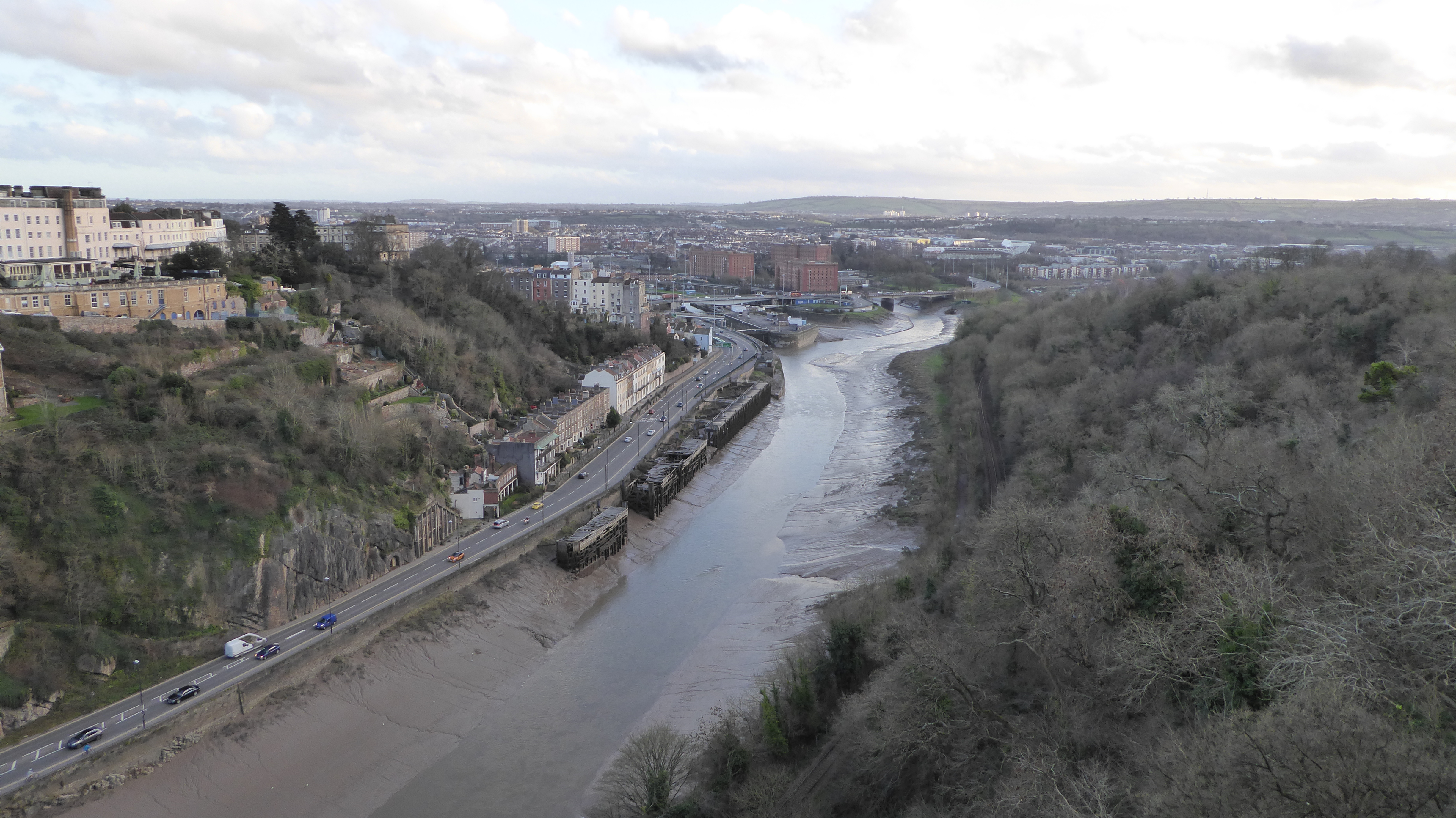
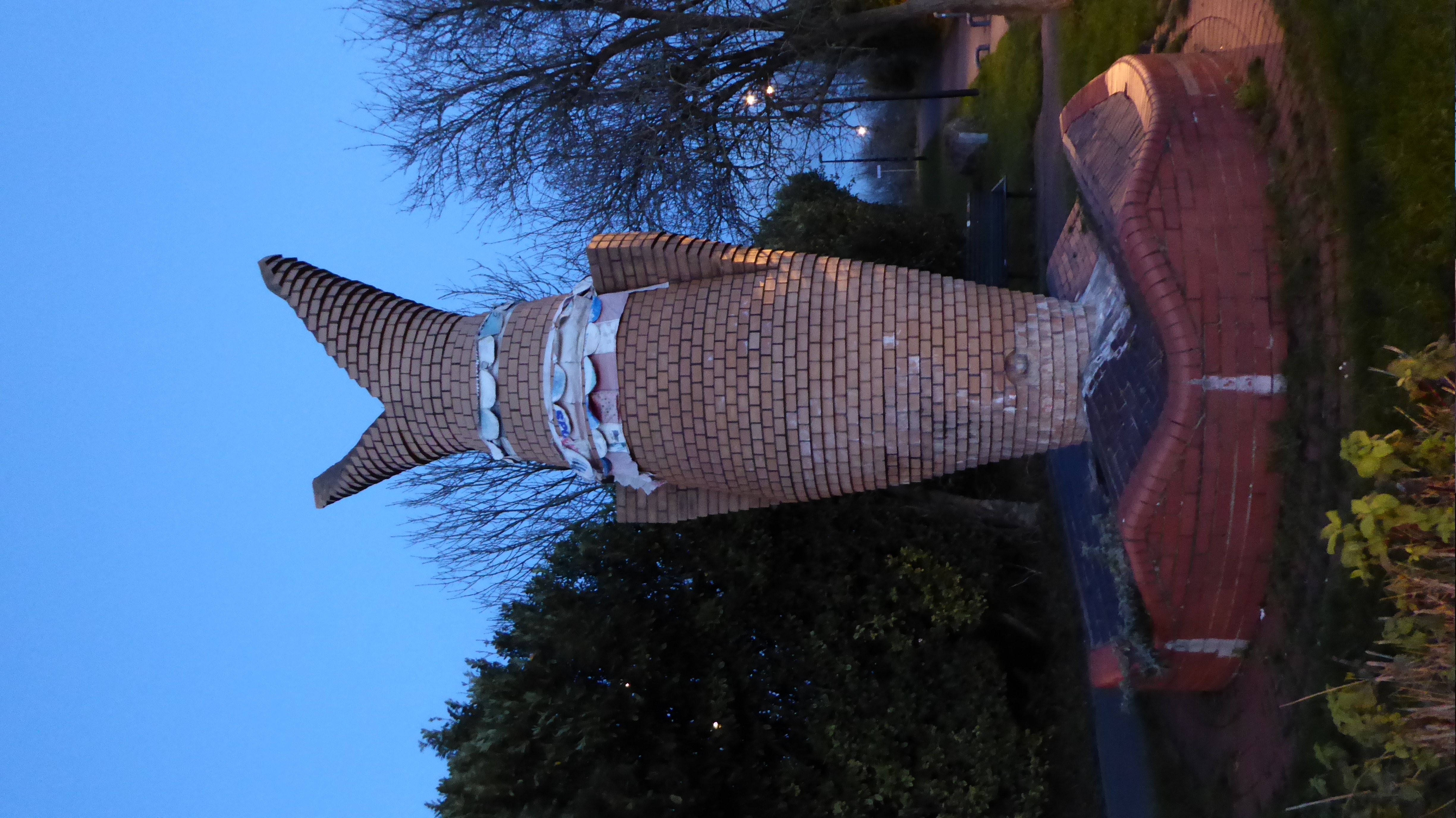
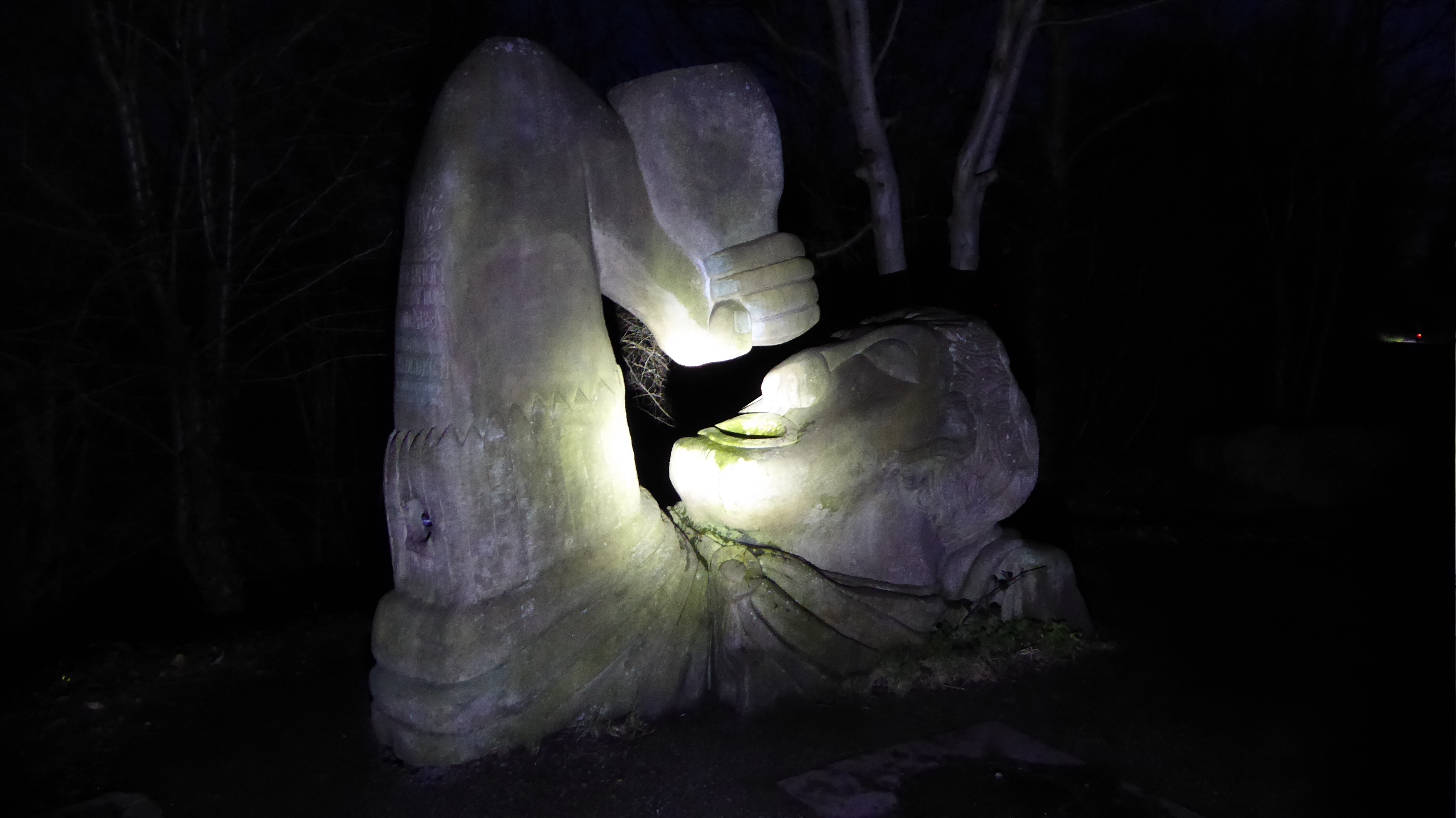
Fernando and I on the Clifton BridgeView to the right of the Clifton BridgeView to the left of the Clifton BridgeThe Clifton Observatory on the top of the clifHow did they get there?Fish on it’s Nose (along the Railway Path)Lots of little sculptures along the path, but only at night you see the light.Nice little details along the path (failed to capture them during the day)This chap has a drinking problemBack to BathBath Abbey
Please rate this post by clicking on the desired star (1 = Awful, 5
= Excellent)
If there is such a thing as a “5-Star” Pilgrim’s hostel, this must be it.
Welcome to the DAY 11 post of our Camino de Santiago Pilgrimage by bike which happened on the 4th of June 2015. We did this stage of 61.89 Km or 38.5 miles from El Acebo de San Miguel to Las Herrerías in 6h and 12 min, of which 3h 58 min were of actual moving time.
Picture taken from the old stone bridge over the Meruelo river in Molinaseca.
I left the 5-Star hostel “La casa del peregrino” about 8 in the morning as usual, and as usual Fernando had already left by then. El Acebo is located at an altitude of 1,130m according to my Garmin and in a period of just 15 min I went down nearly 500 m and covered more than 10 Km distance. The only thing preventing me to go faster was the tight curves and turns of the road, which nearly tricked me once and forced me to go over the opposite lane due to the speed I was riding. Thankfully there was no incoming traffic, or that could have been a problem. In Molinaseca the altitude evened out and remain more or less constant through the ride this day.
Molinaseca Stone Bridge
I crossed through the village of Molinaseca, but not before taking a couple of pictures from the old stone bridge over the Meruelo river, built in Ancient Rome times.
As I arrived in the town centre I found Fernando taking pictures. This town has that wonderful mix of new and old and would be worth staying for a couple of days, if you can afford it. I believe one of the main attractions is the Templars‘ Castle known as the “Castillo de los Templarios”.
Templars’ Castle in Ponferrada
It’s is a well preserved and impressive middle-age edification and has all the characteristics you would expect of a middle age castle.
Main gate of the Templars’ Castle
Fernando and I made a Breakfast stop in one of the restaurants facing the Castle.
Breakfast is served.
After Ponferrada we rode through small towns and villages such as Camponaraya, Cacabelos, Pieros and Villafranca del Bierzo where we stopped for about 15 min for a rest and something to eat and drink.
A Wolf on a bikeVillafranca Castle. Michael, one of our “Camino” friends can be seen riding his bicicle in this picture.
Villafranca de Bierzo is an old medieval town with very interesting architecture, such as the Villafranca Castle, the church of San Juan and other religious buildings such as the Collegiate of St. Maria and the convents as well as the narrow bridge over the river Burbia overlooking the town.
Picture taken from the narrow bridge over the river Burbia.
The route then follows the “snake” like path of the N-VI road alongside the magnificent A-6 motorway (Autovia del Noroeste) crossing under it several times. With its many tunnels and high valley bridges, whose pillars can be seen from bellow, the motorway offers an interesting and modern perspective to the views on the road (N-VI).
Mix of old and new in Vega de Valcarce.
This road also follows the path of the small Valcarce river which lends its name to some of the towns and villages along the way.
As I was pedalling on the shared pedestrian / cycle path, protected from the cars by a concrete wall, I kept looking at small river below and all the green around it and thinking that the people who travel at 70 – 80 mpg on the motorway above will never know the natural beauty that was just below them. This is something you can only experience in slow forms of transportation such as cycling or if you are walking.
Along this route we crossed through the villages or towns of Pereje, Trabadelo, La Portela de Valcarce, Ambasmestas, Vega de Valcarce, Ruitelán until we finally decided to call it the day in Las Herreíras.
Albergue Las Herreíras (Hostel)
Las Herreiras is a tiny village just before the El Cebreiro mountain which is known as one of the greatest challenges of the Camino and we could see a storm approaching in the horizon, so it made sense to stay there. To my knowledge there is only 1 Pilgrim’s hostel in Las Herreíras, appropriately called “Albergue Las Herreíras“.
Detail in Las Herreíras.
The hostel was 8€ for the night and is run by a nice lady who speaks many languages (I’ve overheard she talking in Spanish, German, English and French) who is a strict vegetarian. She offers evening meals, but no meat.
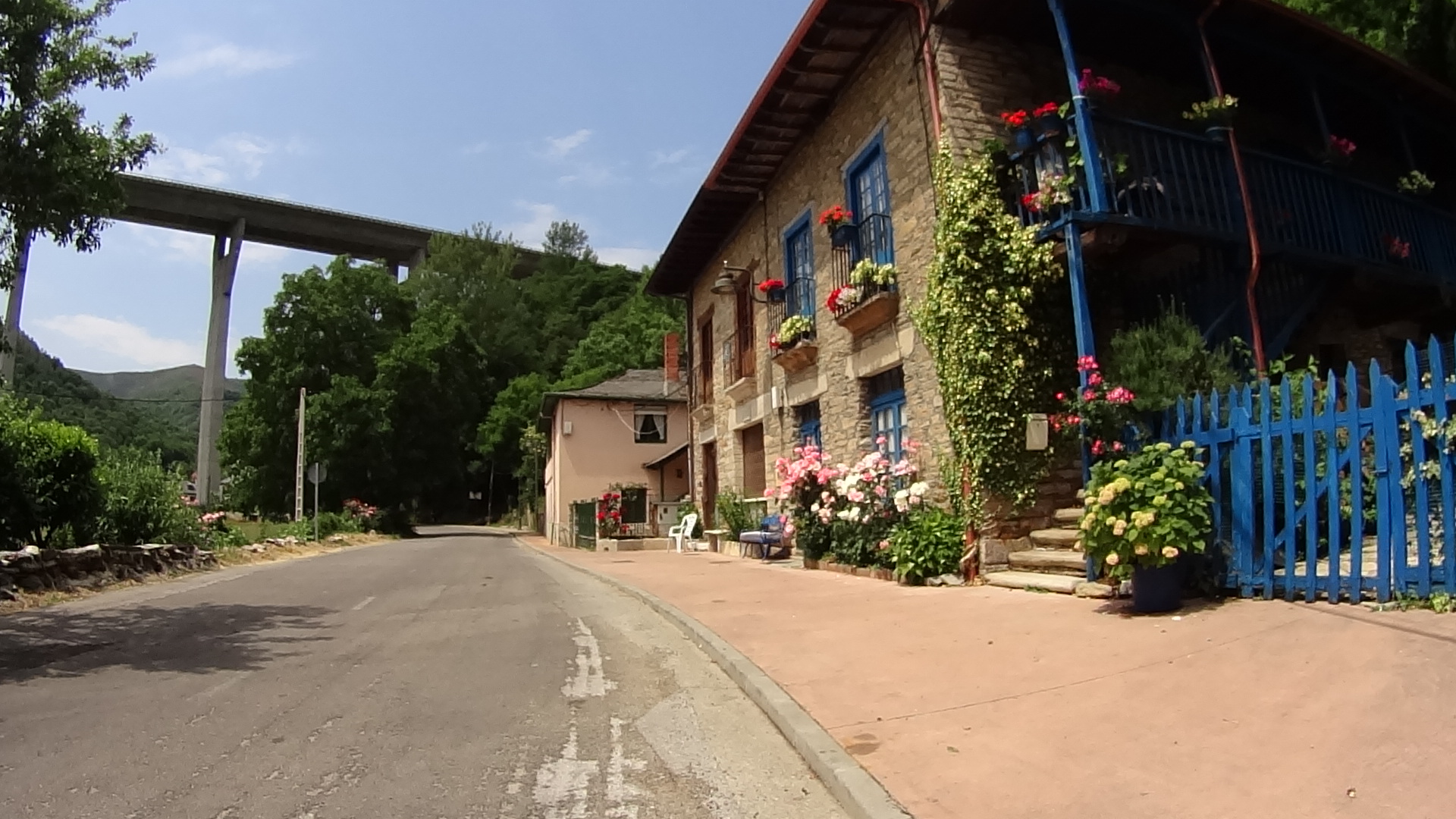
Las Herreíras
She cooks the meal herself and there is no menu to choose from. I believe she charged us 12€ and it had soup, some type of salad as main meal and carrot cake as desert. It was enough and delicious even for a meat eater. Other than that there is only 1 other place in the village where you can get something to eat.
Two Pilgrims of different species
There are essentially only 2 rooms. The upper floor has the main room with about 10 bunkbeds and a small individual room for 2 pilgrims or a couple which costs a bit more (12€, I believe). Downstairs there is a small reception and the common areas with two bathrooms / toilets, a laundry area with a washer / drier and the dining room with 1 big and 1 small table.
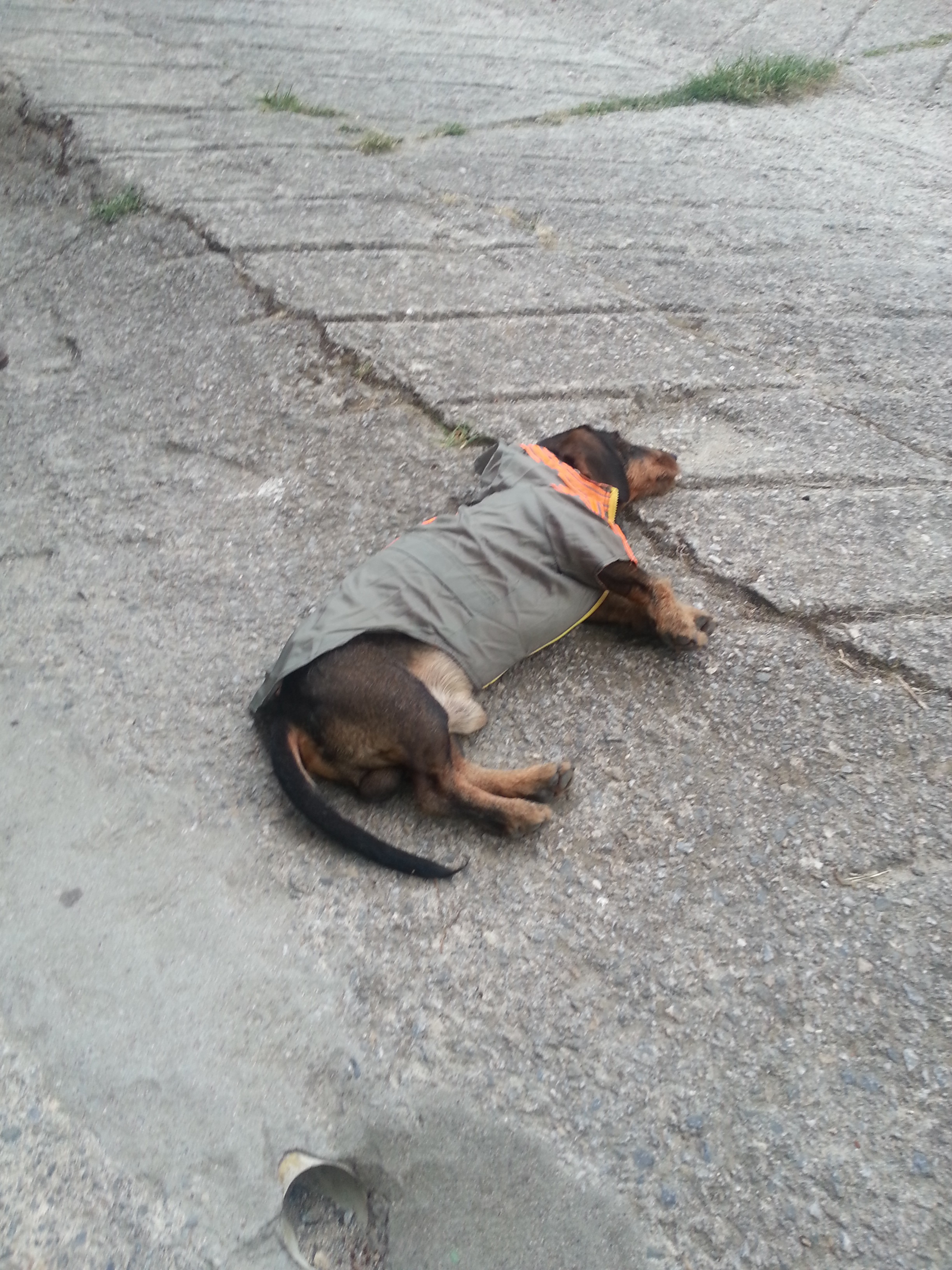
Willy is an 8 year old daschund pilgrim.
After having a shower and handwashing a few pieces of clothes I had a walk through the village and took a few pictures of the small “Las Ramas” river by the village. Moments later the storm came and a flash of lighting appeared to have been the cause of the complete power blackout in the village for more than 1 hour. The time was spent talking to other pilgrims from various parts of the world and playing cards.
It was an enjoyable evening. The “No Wi-Fi” policy of the hostel actually works 🙂
No Wi-FI in the Albergue. “We want you to talk to each other”.
That’s it for day 11 of the Pilgrimage. Please feel free to leave comments, questions or at least indicate if you liked it or not by clicking on the stars in the bottom of the post.
Still far from being a PRO, but I now have a GoPRO… a GoPRO 4 Silver, to be exact.
So far I’ve been using essentially 2 action cams, which I have written about earlier: A Sony HDR-AS30V and a SJCam M10. Both had “goods” and “bads”, but after having done this for a while I thought I needed something better.
After some research I went for the GoPRO 4 Silver edition. I did consider the most expensive model, the Black Edition, for a while, but what won me over to the silver was the ability to see what the camera is filming without having to use a mobile phone over Wi-Fi or something else. The Silver has a touch sensitive LCD display on the back which makes configuring it a lot easier, in addition to actually showing the picture on display and being able to playback straight away.
The Black edition is more powerful, but I didn’t think I was going to start uploading 4K videos to YouTube any time soon.
I also wanted the ability to produce better time-lapse videos. On a long distance bike ride it usually takes many hours to get to the destination. No one, not even die-hard cycling fans, have the patience to watch it for that long (real cycling aficionados use to time to do the real thing, rather than watch it on a screen).
One of my biggest problems with the Sony and the SJCam was the minimum picture interval of 5 seconds. When going downhill, at higher speeds, 5 seconds covers a lot of distance. It becomes especially difficult to keep the notion of continuity if there are many curves or turns, so I was looking for a camera that could do it at intervals of at least 1 second. The newer GoPRO models not only can do it with a minimum interval of 0.5 second (in addition to intervals of 1, 2, 5, 10, 30 and 60 seconds), but it can actually create the video directly in the camera, with no editing needed. You get the real thing straight out of the camera… Great! … and it does work!
One thing I’ve learned in life is that there are always “buts”…
So, it does work, BUT…
Time-Lapse Videos
I’ve learned that the desired 1 sec interval produces video which is way too fast for my taste. What I mean is, the camera takes take 1 frame (picture) each second, but when it produces the video it packs way too many frames per second (not sure how many really, haven’t checked, but must be between 15 and 24). With the 5 sec intervals of the Sony, I was producing time-lapse videos with 3 frames per second, which after many tests, seemed to produce the best results fir my “taste”. I couldn’t find a setting in the GoPRO to define how many frames per second you want the time-lapse video to contain. If anyone knows how to do that, please message me.
On the bright side, it eliminates the “continuity” issue I described above and produces a very “time compressed” 4K video in a small file size, for example a 13 minutes ride was compressed in a 22 seconds video. Some of my Camino de Santiago bike rides had something like a 6 hours duration or more. I can perhaps extrapolate that a 6 hours bike ride would be compressed to just over 7.5 minutes.
I have not tested this, but I believe if I increase the interval to 2 or 5 seconds I will end up with the same issue as described with the Sony camera and still unable to change the rate of frames per second the camera uses when creating the video.
The video below was produced by the camera (I only added the logo and titles in editing) at 1 second intervals on a 4K resolution. Note that YouTube reduces the quality of the original video.
There is also the option to actually configure the camera just to take and store the pictures and not to produce the video. I could then take the many thousands of pictures and produce the time-lapse video myself in a video editing software, as I have been doing, but that is one of the most boring things and that take the most time.
There are only 2 options in resolution. The massive 4K picture size, which means it produces a video of 3840 pixels width and 2160 pixels height. Although things are evolving fast, still most TVs and monitors cannot truly display that type of resolution and only recently YouTube added the 4K option to video uploads. The other option is a 2.7K video (2704 pixels width and 2032 pixels height) which is created in the 4:3 (square) ratio. I could definitively use this resolution, if it was on a wide 16:9 ratio, but not on the old 4:3 one.
Video Recording
There are plenty of GoPRO videos in YouTube and it is not my intention to compete with the professionals in the area (either a professional YouTuber of camera man), but I had, obviously to do my own tests. I am massively disappointed by the fact the new top range GoPRO models do NOT have image stabilization. The Sony I use does and it is excellent. Even the old GoPROs (the HEROs) have image stabilization, so why did GoPRO remove this feature from their most expensive cameras is beyond me. They are supposed to be action cameras, right? And action usually means shaking. Yes, they say you can stabilize the video in editing later, but why do we have to go that extra work if this was already there on their previous models? This was a major let down! I am not returning the camera because of the lack of image stabilization, as I will be keeping my Sony Action Cam and will likely use it to record full HD videos and use the GoPRO mostly for the Time-Lapse option (even though there is no image stabilization in time-lapse either), but (let me say it again) this is a massive disappointment for something considered the best in the market these days.
The video below is a direct upload to YouTube of the video recorded by the camera. When I tried to edit the video to add the logo and title my video editing software produced only a green screen (perhaps some codec issue).
I found this video in YouTube while researching if there was anyway to get the camera do stabilize the image and I think the benefits are very clear here…
Well, that’s it! If this post was useful, please share, comment and let me know if you liked it or not by clicking on the rating stars below.
Thank you!
Please rate this post by clicking on the desired star (1 = Awful, 5
= Excellent)
Welcome to another post about our Camino de Santiago Pilgrimage by bike. This one is special as it covers 2 days of our pilgrimage (well, essentially the was no pilgrimage on the 10th day). On the 2nd of June 2015 we rode 39.5 Km or 24.5 miles from Astorga to the village of El Acebo de San Miguel in 4h and 30m, of which 3h 21m were of actual moving time. On the 3rd of June we gave ourselves some time-off from the Pilgrimage. We woke up late and spent most of the day in the Hostel with a little walk around the village for lunch.
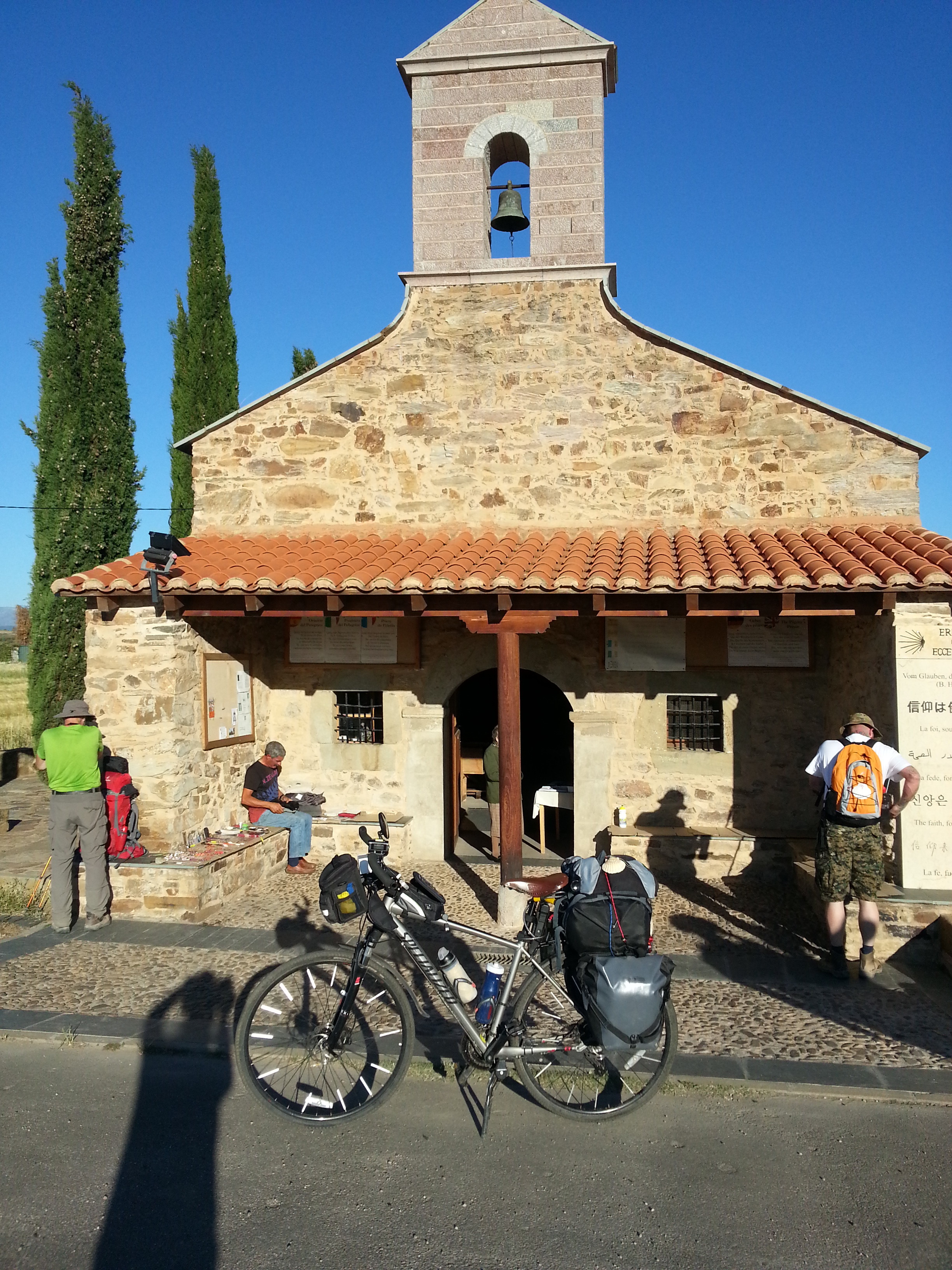
Ermita del Ecce Homo Astorga just outside of Astorga
I was the last to leave the hostel in Astorga that day, not a big surprise. Fernando had left an hour before and I left about 15 min after Marcelo and Alice did. It just took longer to pack the stuff in the bike that day, but then who cares? I wasn’t under any time pressure.
I believe this route from Astorga to El Acebo was one of the nicest in the Camino. It was also somewhat challenging as after Rabanal del Camino you are in for a long 8 Km climb of almost 500 m (from about 1,000m in Rabanal to about 1,500m just before the Iron Cross), but I am going ahead of myself again.
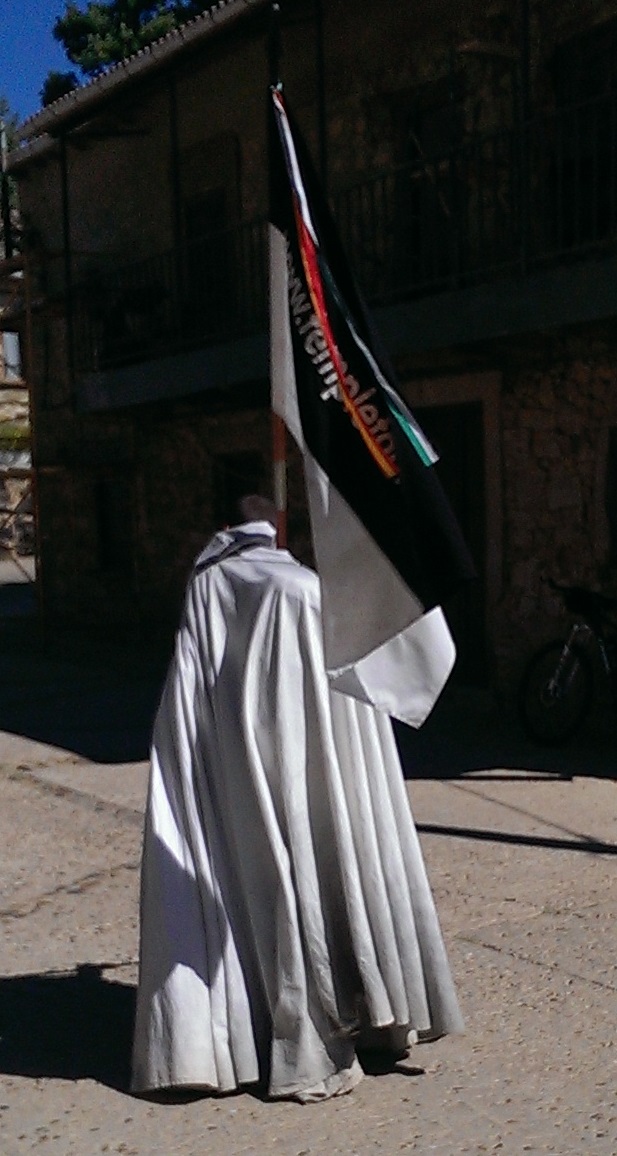
One of the most interesting pilgrims we encountered, at least from a dressing code point of view.
Just outside of Astorga on the LE-142 I came across the “Ermita del Ecce Homo” (Chapel of Ecce Homo or Jesus Christ) a house from the 17th Century where pilgrims can rest and refill their water bottles.
After Murias de Rechivaldo I left the LE-142 and took the same dirt track used by the walking pilgrims. The pilgrim traffic was quite intense which forced me to go slow, but I rode that dirt track for only about 3 Km until I reached the LE-6304 from where I rode on tarmac again to the village of Santa Catalina de Somoza.
Marcelo made a new friend.
This was likely the longest portion of dirt tracks I rode that day (plus a few minor ones not even worth mentioning). After Santa Catalina de Somoza I crossed through the village of “El Ganso” and continued on the LE-6304 towards Rabanal del Camino, where I met Fernando and stopped for something to eat and drink.
His rucksack was behind the cape.
Few minutes later Marcelo and Alice arrived also and we all spent some time talking. It was then that a “figure” of the camino walked passed by us. I don’t know who this pilgrim was and I suspect he didn’t walk the way to Santiago as we met him a few more times until we reached Santiago, but the portions he walked he did dressed as a Templar and carrying a flag, so I guess you can understand why I called him a “figure” before.
Long climb to the Cruz de Ferro.
After Rabanal the long climb, as mentioned before, is rewarded by the views and the wild flowers and vegetation of various colours that grow alongside the road. The climb is long, but not very steep, making it perfectible manageable at least until some 500m past Foncebadón where it becomes steeper, perhaps about 15%, but is not very long. Both Fernando and I had to push the bike on that stretch.
EyeCycled to the Cruz de Ferro.
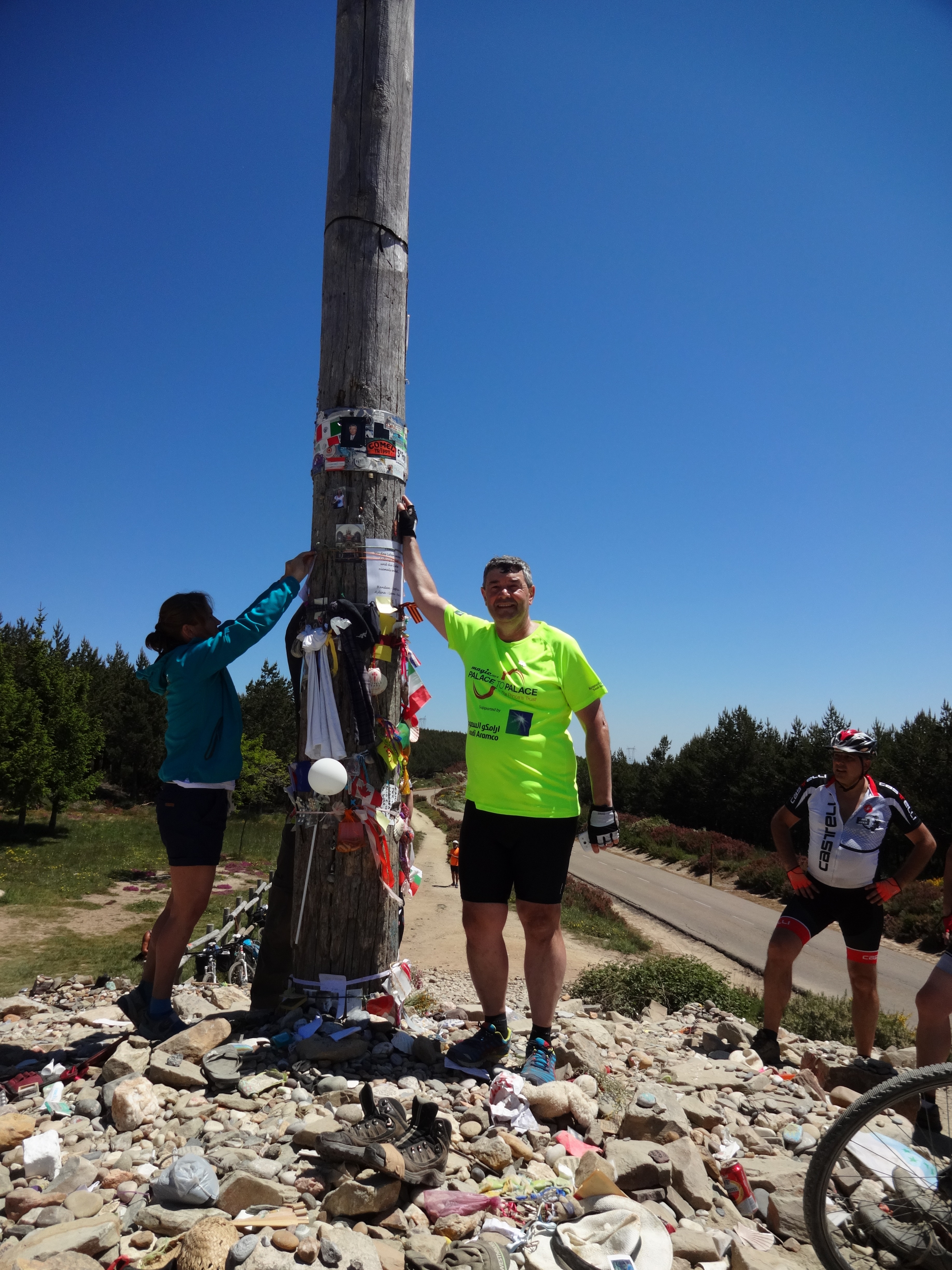
After Foncebadón we arrived at another landmark of the Camino: The “Cruz de Ferro” or Iron Cross, consisting of a wooden pole about 10m high surmounted by an iron cross. At its base there is a mound of stones that was formed over the years by Pilgrims that bring stones and leave them there. A legend says that when the Cathedral of Santiago de Compostela was being built, pilgrims were asked to contribute by bringing a stone.
Proud of myself.
The tradition is now to throw a stone there, brought from the place of origin of the pilgrim, symbolizing what the pilgrim wants to leave behind and get ready for rebirth on the last part of the Camino.
Proud of my friend.
I didn’t bring any stone with me, but I think I left something behind and kept the satisfaction of having achieved it. Fernando and I arrived at the Cruz de Ferro together and Marcelo and Alice a few minutes later.
In honour to my children, who will always be with me, no matter where I am.
We spent quite some time there resting, talking and watching the other pilgrims arrive.
After the Cruz de Ferro there is a long and pleasant ride down all the way to El Acebo with some magnificent views of the mountains.
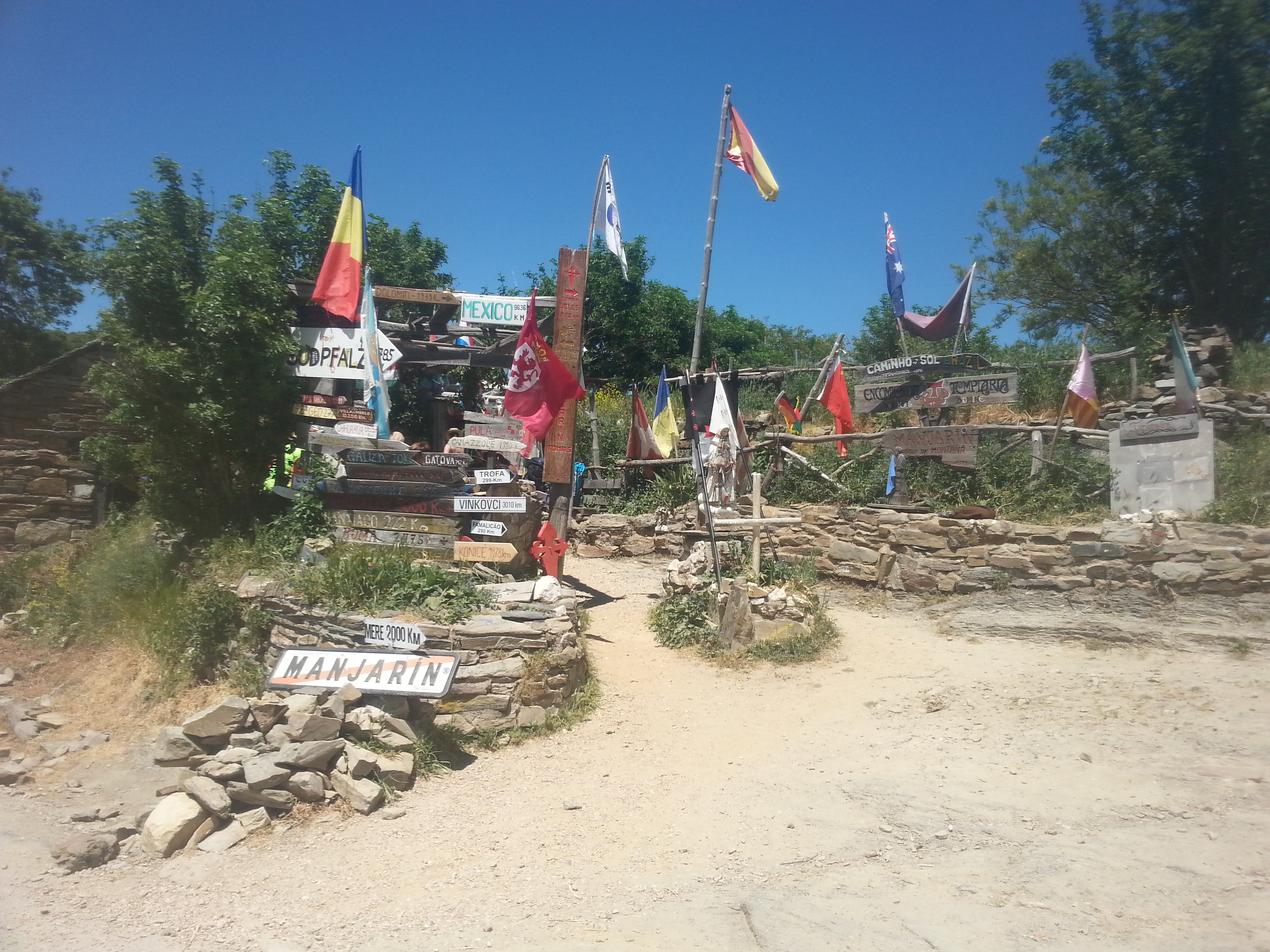
Manjarin
Fernando and I got separated from Marcelo and Alice who stopped at Manjarín, possibly attracted by the Brazilian flag and the many signs there.
As we arrived in El Acebo, I saw an ad about a recently opened Hostel and the pictures looked very good, especially the Olympic size swimming pool of t
he hostel. Fernando and I decided to check it out and almost could not believe our eyes. If there is such a thing as a 5 star pilgrims’ hostel, that must be it, but I´ll let the explanations for day 10.
The video below is a compilation of the climb towards the Cruz de Ferro.
The next video is of a view from the Cruz de Ferro and Fernando’s testimony.
Day 10: No cycling, just lazing up at the “La casa del peregrino“, a newly built “5-star” hostel in the camino.
Entrance to the El Acebo Pilgrim’s Hostel.
Well, given the excellent facilities of this hostel and the price we decided to reward ourselves with a free day after the 520 Km of cycling since we had left Saint Jean Pied de Port 10 days earlier.
If there is such a thing as a “5-Star” Pilgrim’s hostel, this must be it.
We could afford if both financially and in time as we still had 11 days left and only about 300 Km to go until Santiago.
Up to that point we had stayed in pilgrims’ hostels that were normally very simple in nature, with overnight costs varying from 5 € to 22 € (the first one in Saint Jean), but mostly around the 8 € to 10 € mark.
Good life.
This hostel is also 10 €, but the value you get for your money is unbelievable. Mind you, it is still a hostel, in the sense that you sleep in rooms with several bunkbeds and share them with other pilgrims, but even that was amazing in this hostel.
Dinning Room
For 10 € you get a bed with your own individual light and 2 individual power sockets just for you (a luxury compared to other much older hostels) and your very own locker (reception provides a key).
Hostel Bedroom.
Also Wi-Fi is available everywhere in the hostel (or at least it worked everywhere I tried, from our room to the common areas, but not in the pool).
One individual light and 2 power sockets for each Pilgrim… a luxury.
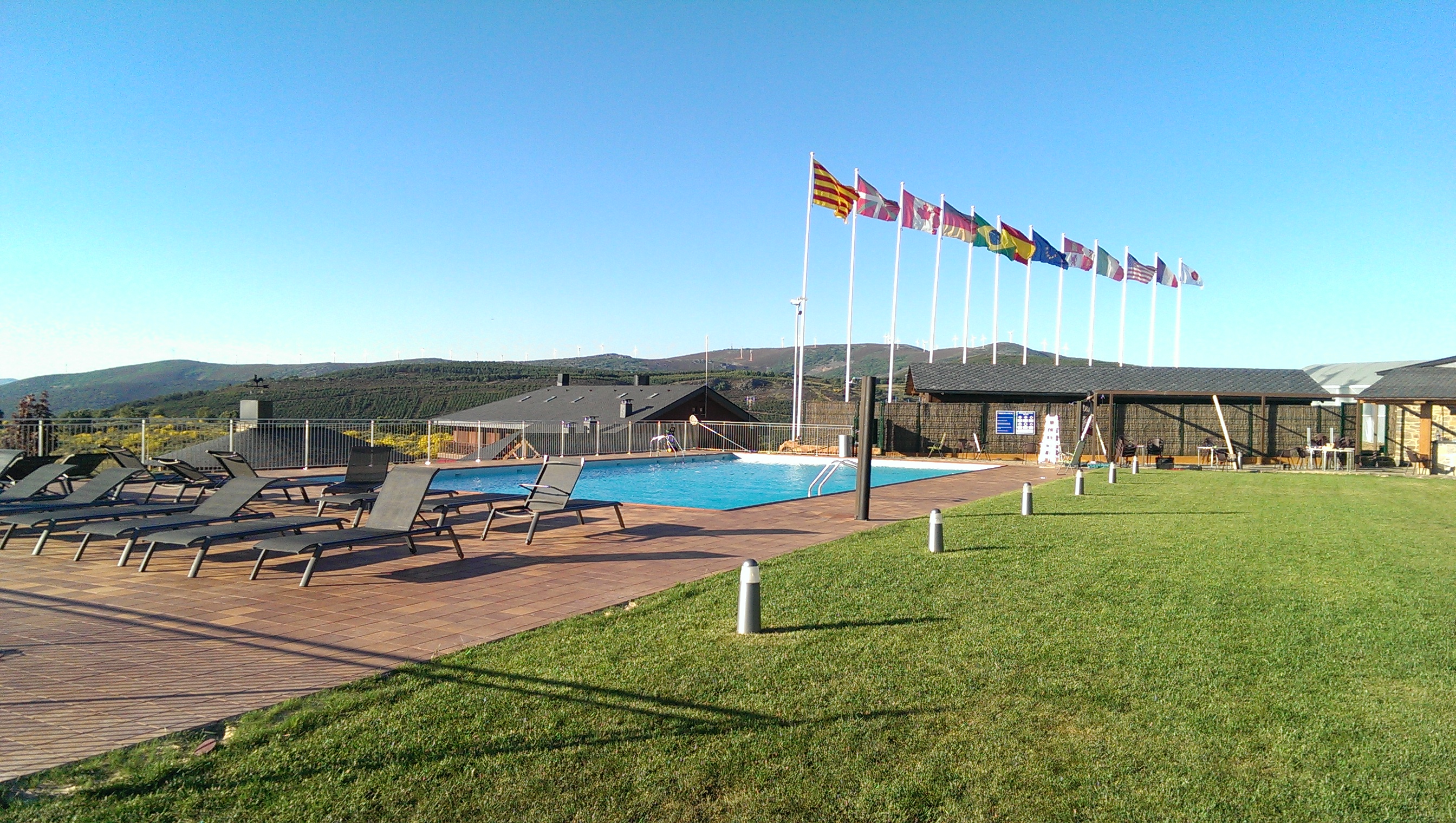
You also get amazing views, laundry service (at a cost of 4 € per wash – there is also and outside washing area with clothes dryer if you, like me, want to hand wash your clothes) a little supermarket on the basement, a huge BBQ area, children’s playground, many outside sitting areas to enjoy the view, a bar, an always manned reception and believe it or not an “Olympic” size swimming pool with a crystal clear, but very cold, water that comes from the mountain.
View from the swimming pool.
The toilets, bathrooms, shower rooms are impeccably clean, modern and with an amazing hot water pressure. Everything is electronically controlled from the flow of water to the touch sensitive light dimmers (yeah, my geek side is taking over, sorry).
Crystal clear, but very cold water.
The room we stayed had 4 bunkbeds (8 beds), but on our 1st night we had the room just for us. On the 2nd night we were joined by 4 more pilgrims.
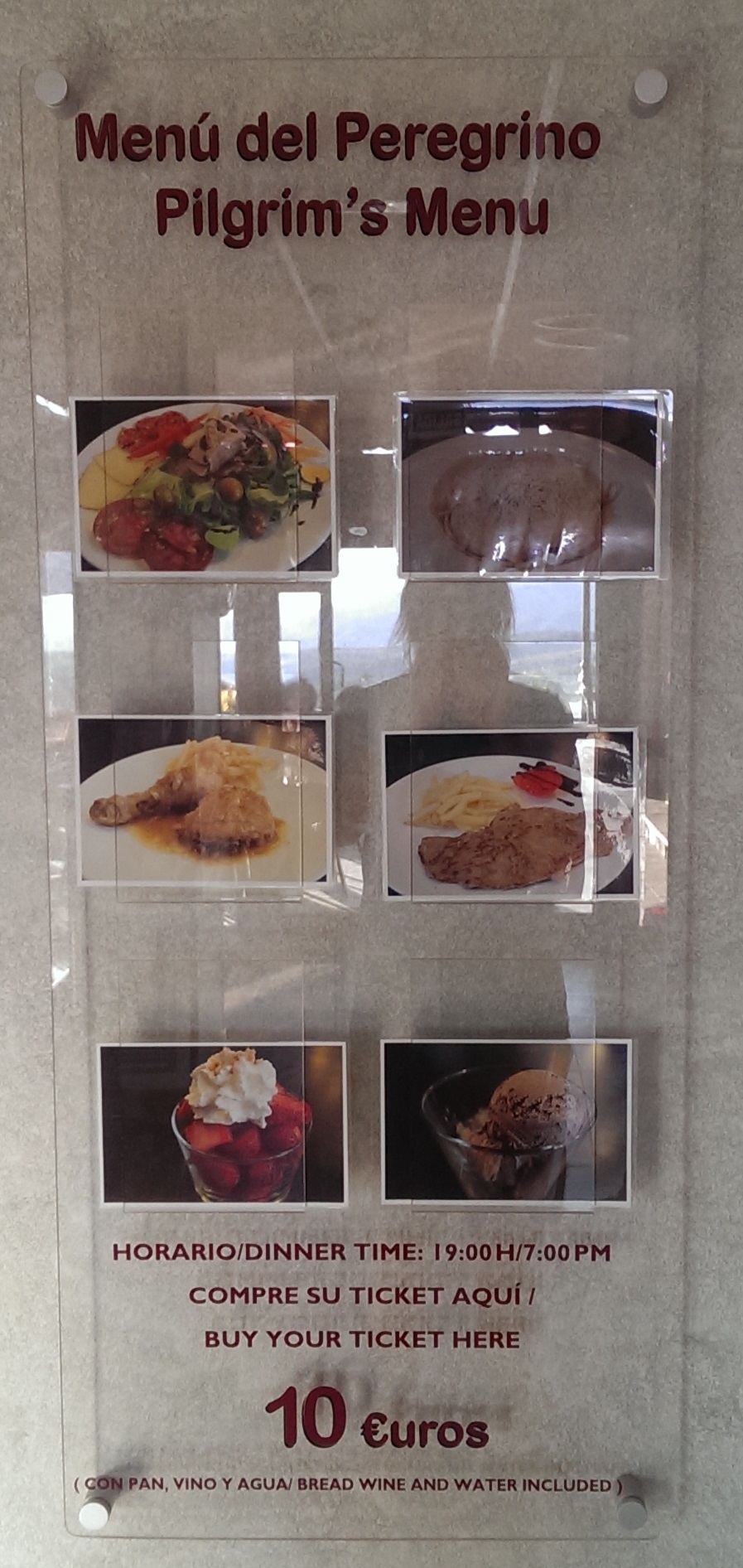
Pilgrim’s Menu
Not trying to diminish the old guest houses and hostels we stayed along the Camino, but it was refreshing to stay in a newly built place with all the benefits of the 21st century at our disposal.
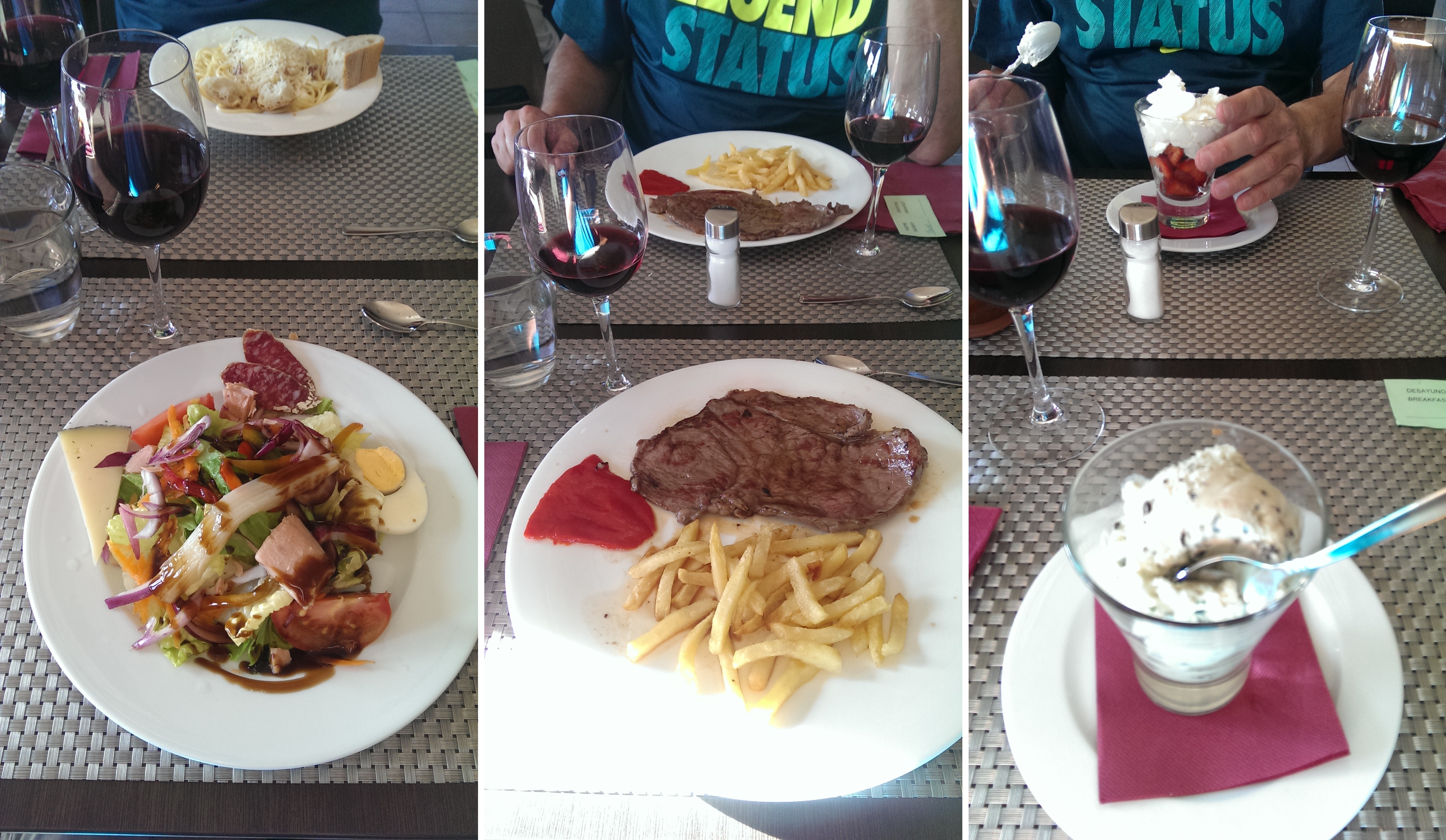
Now, to the food… The pilgrims menu offers, as usual, 3 choices of a 3 course meal, accompanied by bread, water and wine. I think I will just let the pictures talk for me and say it was delicious. For 10 €, this is very hard to beat anywhere in the world, I think.
On that day we woke up late and walked to the village, as the hostel is about 200 m down the road.
Starter, Main Course and Desert.Main street of El Acebo
The village of El Acebo de San Miguel is tiny, with just a few houses along the main street, but there is an indescribable charm to it.
El Acebo
The houses are very old and a few appear to be in really bad shape (nothing more than a pile of stones, really). We walked to the top of the village where the water fountain is and had lunch at a place called “La Tienda”, which also offers rooms to Pilgrims. Like many other Spanish Villages along the Camino, El Acebo must be extremely dependant of the pilgrim tourism and it is likely that in high season a lot more pilgrims stay there than there are inhabitants.
View from the Hostel’s Balcony
Well, that’s it for days 9 and 10 of the pilgrimage. I´ll add a few more pictures below. Please feel free to leave comments, questions or at least indicate if you liked it or not by clicking on the stars in the bottom of the post.
Welcome to the DAY 8 post of my Camino de Santiago Pilgrimage by bike which happened on the 1st of June 2015. I did his stage of 50 Km or 31 miles from León to Astorga in 4h and 35m, of which 3h 22m were of actual moving time.
I left the hostel at 8:01am that morning and first rode to the Cathedral. I didn´t really need to go there, but I felt compelled to take one last look at the Cathedral. As I arrived I saw a cyclist’s couple looking at a map and when I approached them I recognised they were also from Brazil.
Leon Cathedral at 10 past 8 in the morning.
Marcelo and Alice are from a city in Brazil called Recife, the capital of the state of Pernambuco, and were also doing the Camino de Santiago. We talked for a few minutes and left together to try to find our way out of town.
5 Star Hotel Parador in León, for Pilgrims with a lot of cash.
Little did I know at that time that we would later arrive in Santiago de Compostela together. Our friendship started at that point and continues to this day thanks to social media and the internet.
León is a reasonably large city and it took us about 1h and 20 min to reach La Virgen del Camino, which still belongs to León’s metropolitan area and is very close to León’s airport. We stopped at a place called Cafeteria Miravalles for Breakfast and 50 min later jumped back onto our bikes again and continued to ride on the already familiar N-120. We rode on the N-120 all the way to Astorga this day.
This Pilgrim slept with the birds.
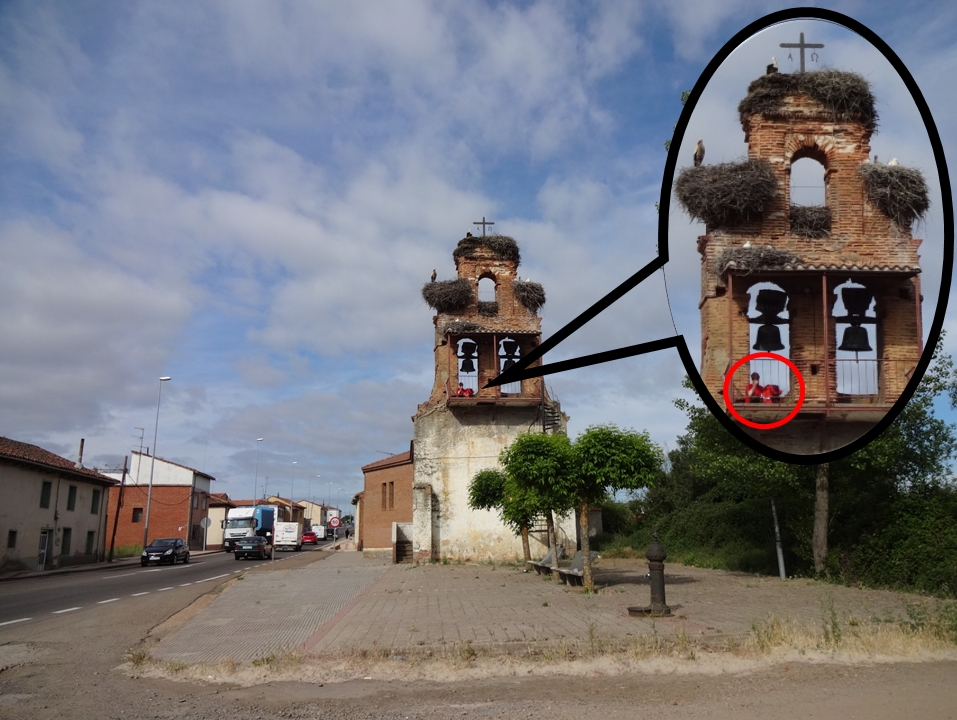
As we arrived in the village of Valverde de la Virgen we saw something interesting. Spain is filled with old bell towers (for the lack of a better name). In many of them you will find White Stork’s nests. In this particular one a pilgrim decided to stay overnight and slept with the birds.
Stork’s Nest in Hospital de Órbigo.
Some pilgrims actually camp throughout the entire pilgrimage, especially those with animals, and don´t stay at hostels, like most do. I don’t know if this was the case for that pilgrim, but I thought he had chosen a very interesting place to sleep, if he managed to get any sleep at all, that is.
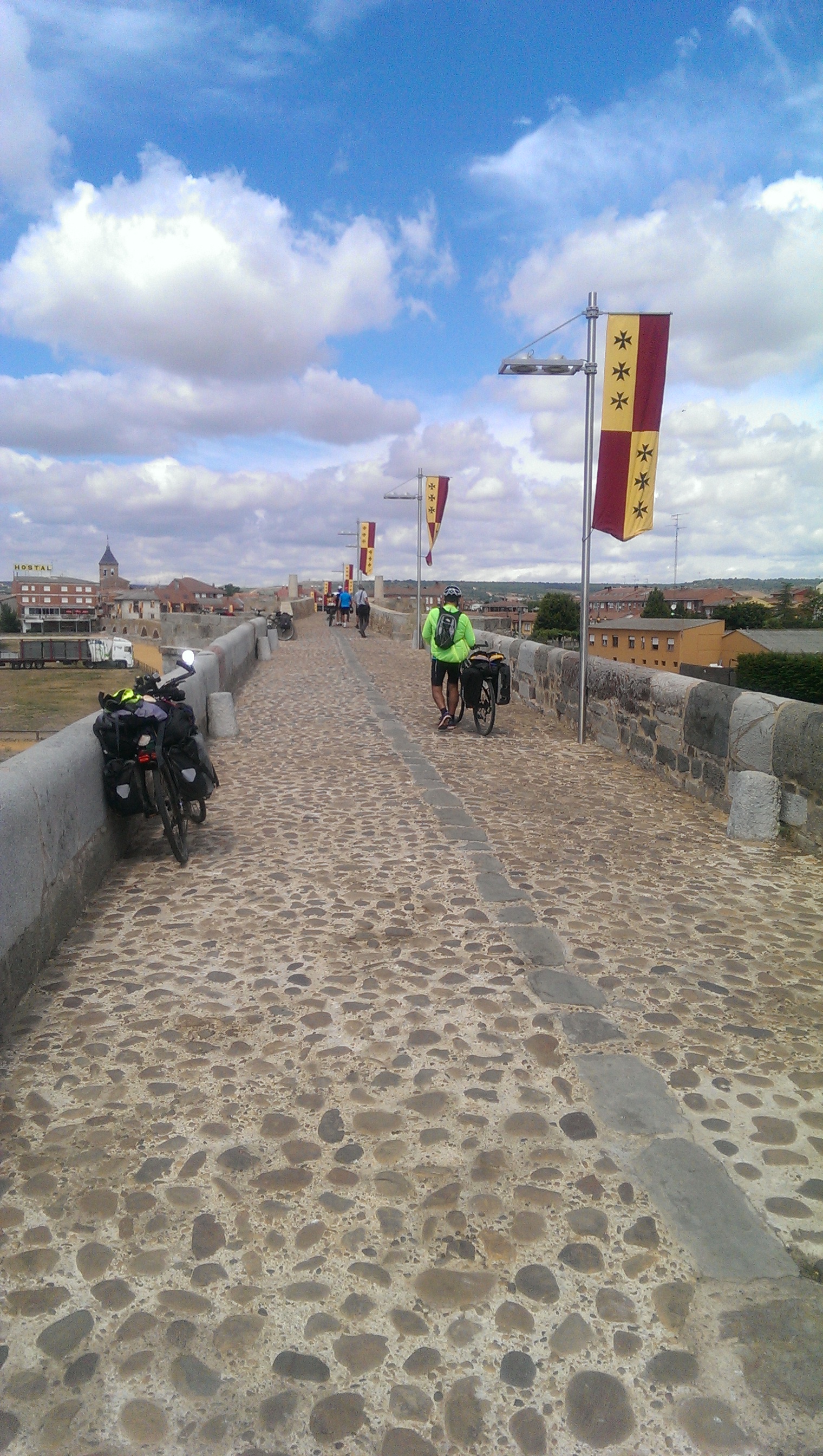
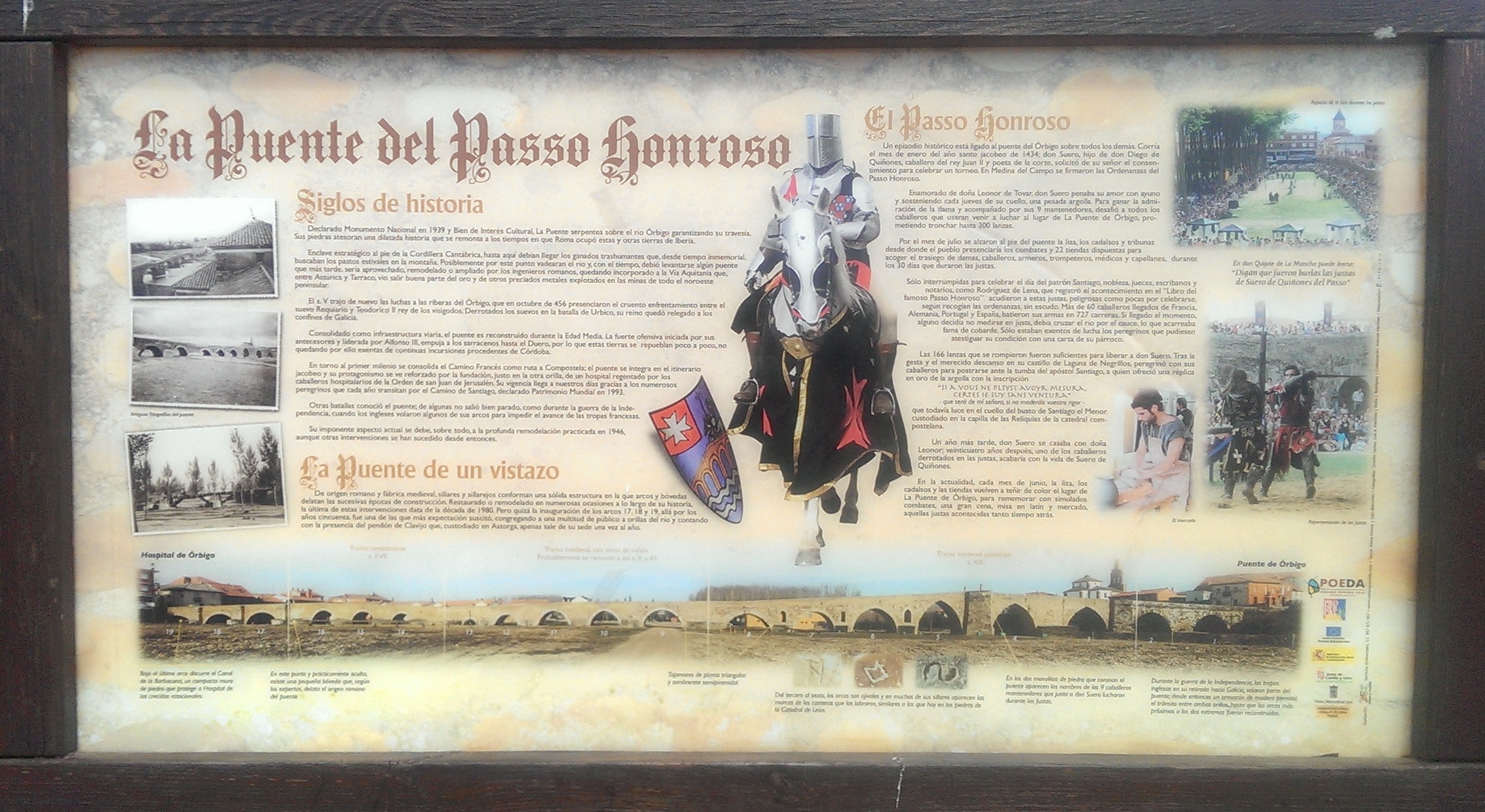
The honourable step bridge (La Puente del Passo Honroso), Hospital de Órbigo
After Valverde de la Virgen we crossed through the villages of San Miguel del Camino, Villadangos del Paramo and San Martín del Camino until we arrived at yet another landmark of the Camino:
Medieval Bridge over the River Órbigo.
The 13th century medieval stone bridge over the river
Órbigo in the small town of Hospital de Órbigo, which owes its name to the old pilgrim’s hospital that once stud in that place. The bridge appears to be way too big for the river, but before the construction of the reservoir Barrios de Luna, the river had a great flow.
It has 19 arches and is fairly well preserved.
Bridge over the River Órbigo (the Honourable Step Bridge)
We did a small pit-stop right after the bridge for some rest and water and moved on back on the N-120. The rest of the way to Astorga was relatively uneventful.
Astorga’s Municipal Hostel
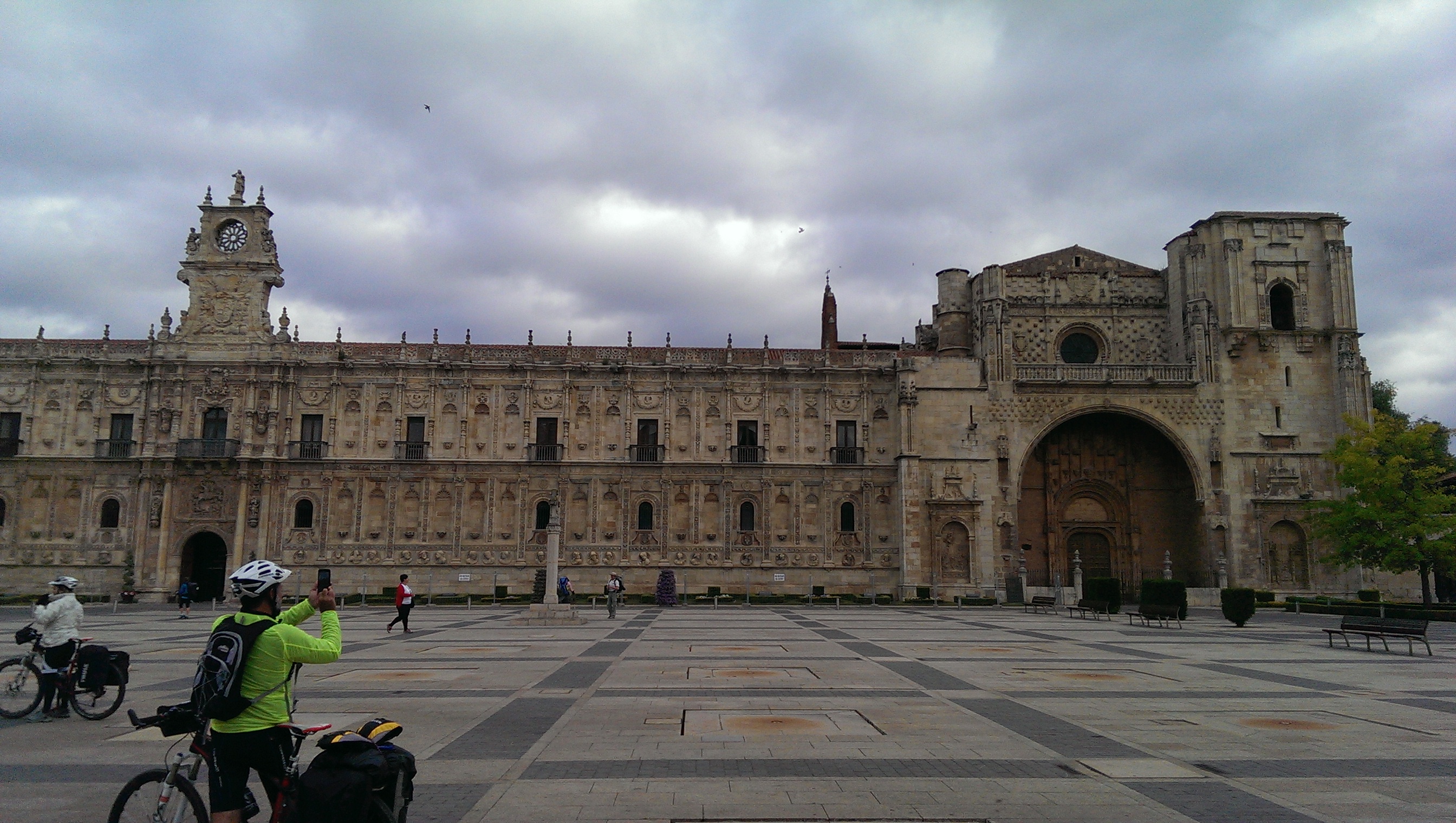
As we arrived in Astorga Marcelo and Alice decided to stay in the Municipal Hostel straight away and I went to the town centre to find Fernando, as we had agreed to meet there and ride together the next day. Once I found Fernando we went back the municipal hostel and stayed in the same floor Marcelo and Alice were staying.
I do recommend this hostel. The overnight is 5€ and it’s clean and well organized. Most rooms have only 2 bunk beds (or 4 beds) and we shared the room with 2 pilgrims from Germany.
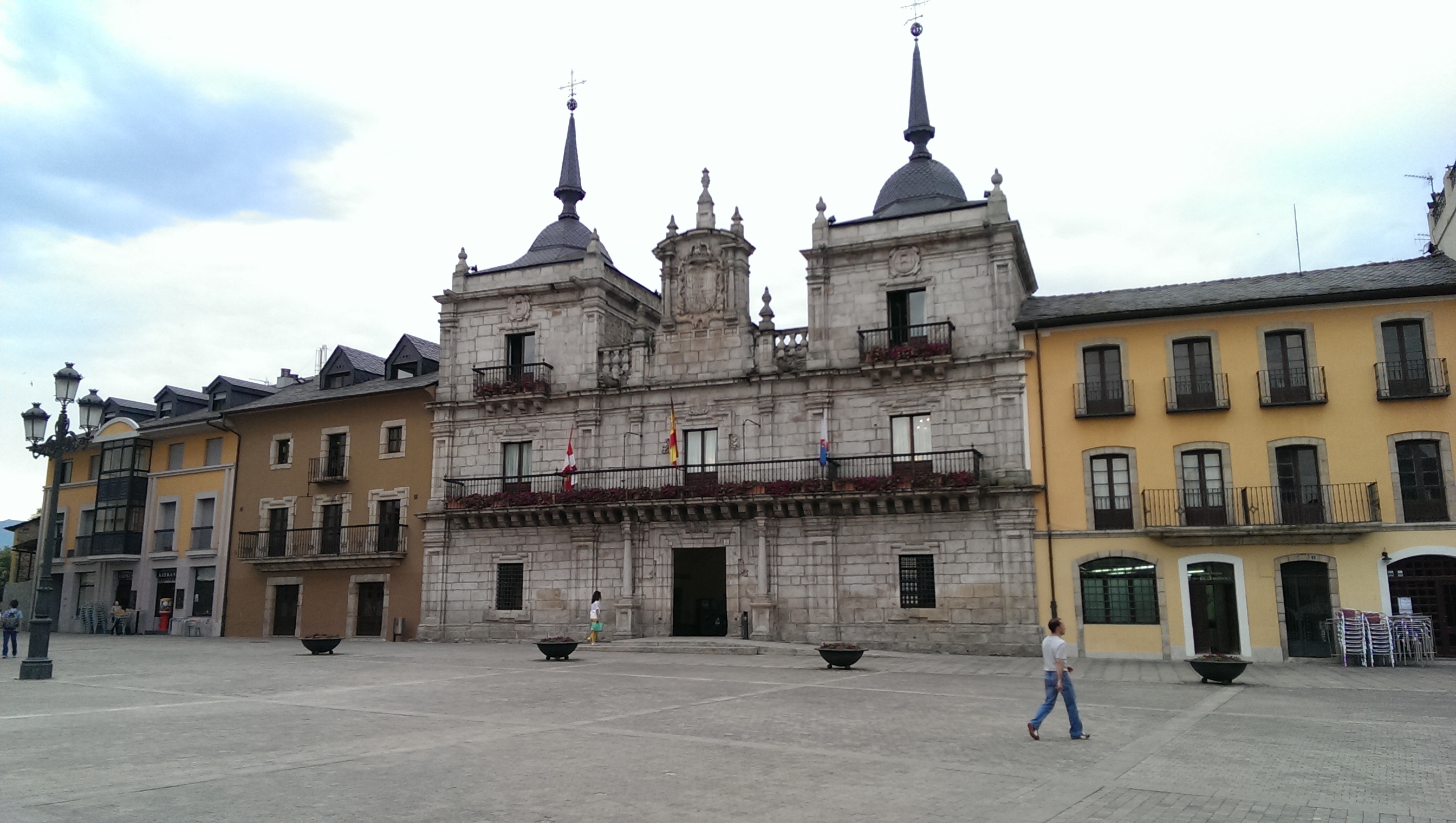
Town hall of Astorga
Be prepared for walking up quite a few stairs if you, like us, stay on the upper floor (the bikes stay in the basement). The view from our room was great though. The hostel had a fully fitted kitchen and a laundry with a drying area outside on the rear garden.
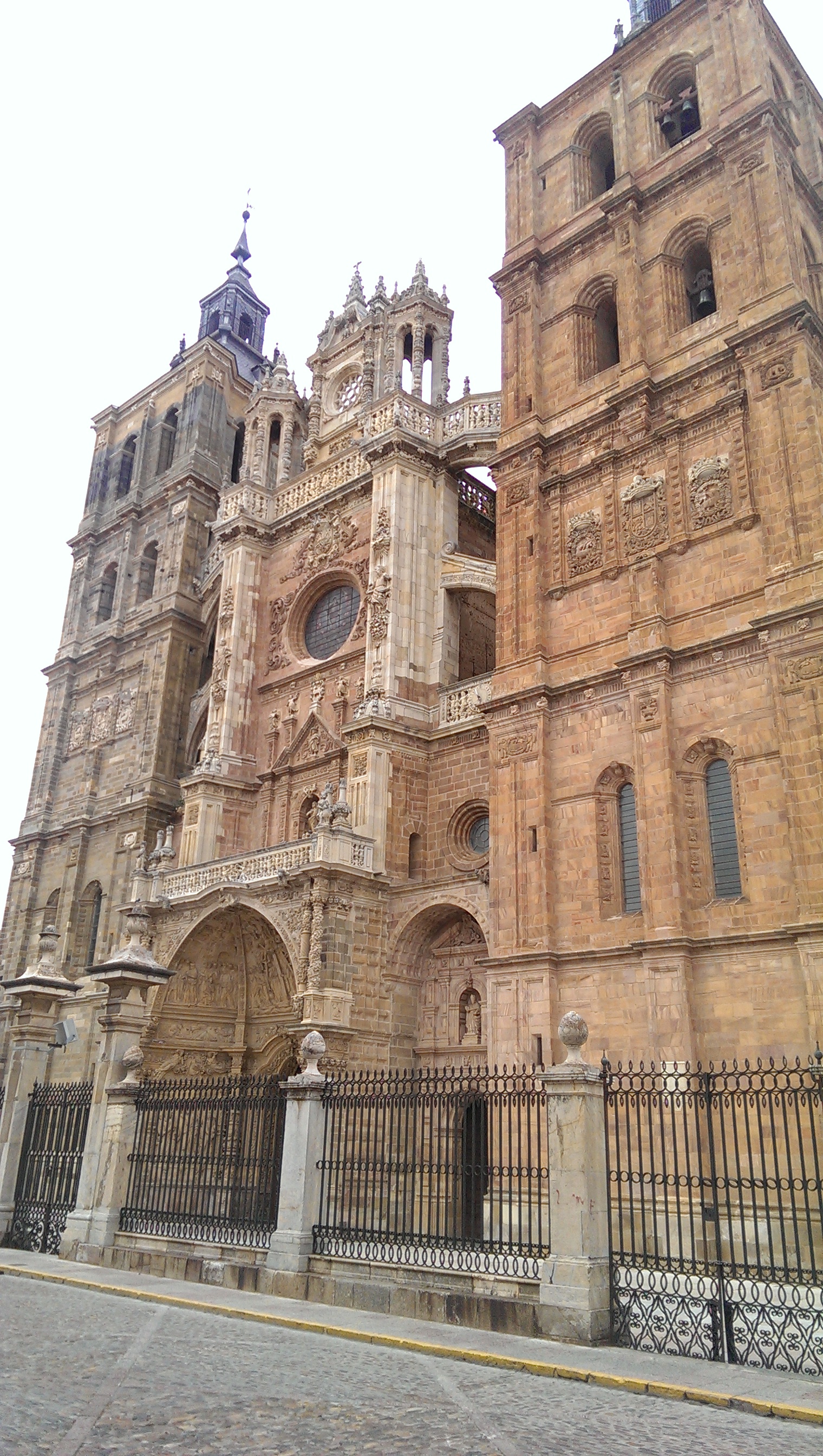
Astorga’s Cathedral
After a shower we left the hostel to explore the town. Astorga is great place, with an especially interesting architecture. I know I wrote this before, but although the town is small it feels big and welcoming and has a very long history as it pre-dates León by 875 years. According to Wikipedia, artefacts dated 2750 BC were found in the area of Astorga. The local Celtic people, known as the Astures and the Cantabri, inhabited the area around 275 BC, which later in 146 BC became one of the Roman strongholds in the region called Asturica.
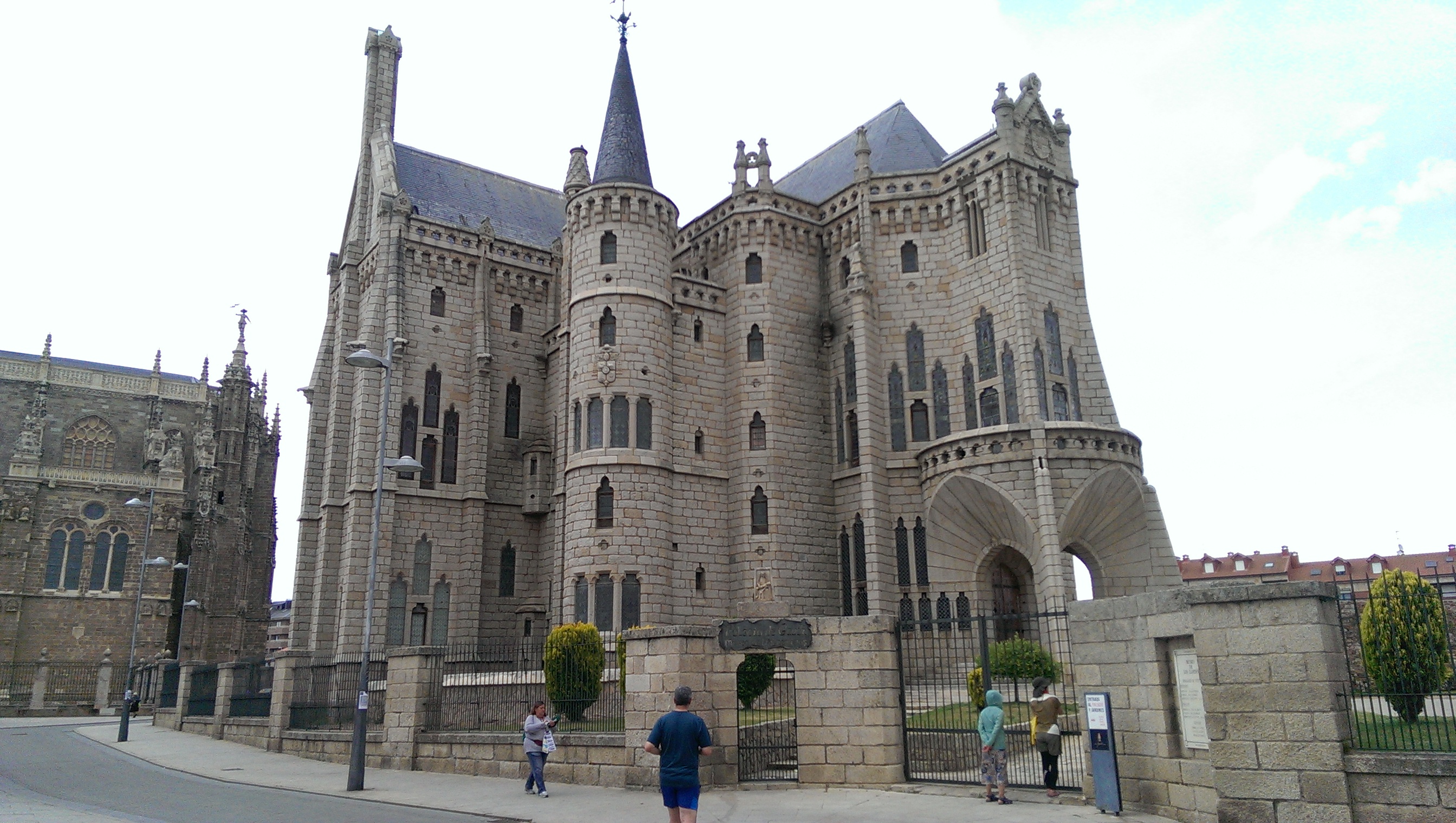
Episcopal Palace of Astorga
As in many Spanish towns Astorga has a great Cathedral, but it also has the Episcopal Palace of Astorga, which was a building designed and partially built by Gaudi, the same architect who design the famous Sagrada Familia Cathedral in Barcelona. The building now houses a museum of religious art called “Museo de los Caminos”, dedicated to the Camino de Santiago.
Cathedral and Episcopal Palace of Astorga
As we were exploring the town, the 4 of us, Fernando, Marcelo, Alice and me, decided not to eat in a restaurant that night, but to buy food in the local market and cook it in the hostel’s kitchen. Marcelo is the chef and owner of several well-known restaurants in his home city and, obviously an excellent cook. We had a great time preparing and enjoying the food that evening, together with the other Pilgrims there, all accompanied by good Galician wine.
Well, that’s it for day 8. Please feel free to leave comments, questions or at least indicate if you liked it or not by clicking on the stars in the bottom of the post.
I missed spinning class today again. It’s becoming a bad habit and bad habits need to be broken, so I decided I am going to try harder to cycle at least 2x (perhaps 3x) a week, no matter the weather.
Well, let’s make an exception for when is raining shall we?
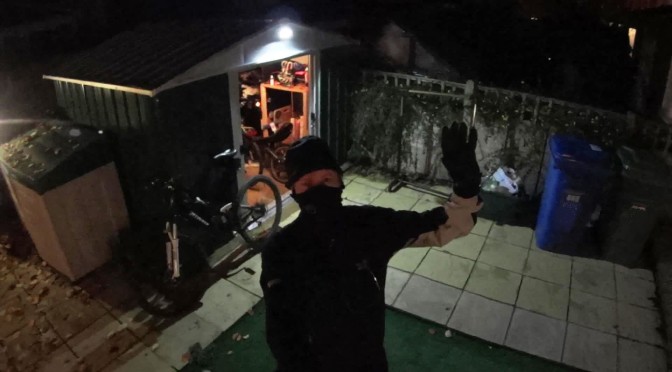
So, it was about 6pm here and the sun had long gone. It was a really dark night today. Should I, perhaps, have chosen a more moon lit night to record the ride? I can always record it again.
Before you start watching the video, I have a few confessions to make:
I lied! I am a member of a secret Ninja society (in my dreams at least).
I am not, however, and never have been a thief, unless stealling female hearts count (in my dreams at least).
I was a bit overdressed and when I got back home was dripping sweat. The weather has been very mild this week, but I prefer sweating a little than to feel cold… and once you’re out, you never really know what you´re going to get in this country.
The sound quality of my speech at the start of the video was pretty bad, so I voiced over it in editing.
This was essentially the same 21 Km route (with a few minor changes), I did with my children last weekend.
With that said, let´s go ride!
If you like the post or the video, feel free to, errr… “Like” and Share it on social media or click on the stars below to let me know how I am doing.
Thank you!
Please rate this post by clicking on the desired star (1 = Awful, 5
= Excellent)





































You must be logged in to post a comment.